Column 03 — Field Note
Flow Is the Design
of Emotion.
On July 10th and 11th, 2026, I traveled alone to Naoshima, an art island in Japan's Seto Inland Sea — trusting the "you absolutely have to go" of a creator I deeply respect. The Chichu Art Museum I met there shook me so hard that I had to write this field note.
01The whole town is art
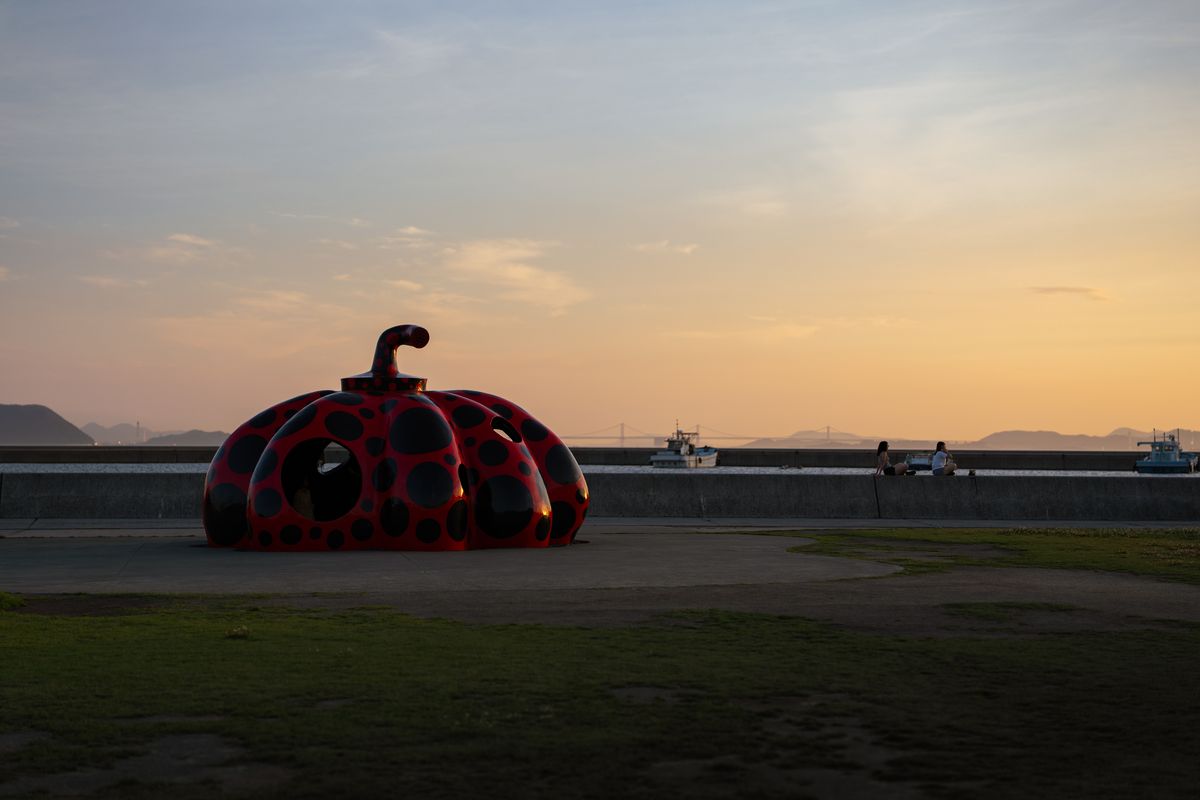
I won't go on too long, but first, a word about Naoshima itself. The whole town is art. You never get bored walking; there are structures tucked everywhere that make you go, "so this is here too" — buildings worth seeing at every turn. Honestly, you could stay for days.
Work there, walk, exercise, meditate, read, do nothing at all — all good. It would be a wonderful trip with family, too. It's an island, so there is the sea, the hills, the meadows, and art standing among them. There is plenty for children to enjoy, plenty that stretches the senses. I recommend it with all my heart.
02Chichu Art Museum — "no photos" works
Now, the thing that moved me most, the thing that pierced deepest: the Chichu Art Museum. It was simply overwhelming. The shock was so strong that I suspect my baseline for "I love this space" — my likes and dislikes — will be built on what I felt there. Honestly, it was the first museum that made me think: I love this place, I want to stay, I want to understand it.
First of all: photography inside is strictly forbidden. "Please put your camera away," the signs say — you cannot shoot anything inside. So you cannot know it without going. And that, it turns out, is very good.
If photos had been allowed, I would probably have wanted to shoot everything, click click click, and become absorbed in that instead. Feeling with my own eyes, digesting inside myself — I'd have skipped all of it in favor of "getting a good shot" and "having something to show off." That this didn't happen was, I now feel, a gift.
03Walter De Maria — the queue tunes your eyes
My favorite was the Walter De Maria work, on the lowest underground floor. It is simply too much. The impact of the moment you enter; the disquiet of the moment your eyes are seized. Alien, yet beautiful. It was a shock.
Here is the interesting part: the small room before the main space. You are made to queue in a rather dark waiting room. They limit entry, so you wait — and the waiting itself is what lets your eyes adapt to the dark.
On top of that, a staff member gives every single group a one-to-two-minute briefing: "this place is such-and-such, please mind this and that." Frankly, everyone in the line behind can hear all of it — "yes, we know" — but they do it properly, for each group. As a result a decent queue forms, your eyes keep adjusting to the darkness, and the impact of the moment you finally enter becomes something enormous.
What waits inside is a huge skylight and a grand staircase facing it. I'll keep the rest for your own visit — but let me say there is what looks like a giant steel sphere placed at the center of the stairs, directly beneath that skylight. For a moment I genuinely felt the sphere might come rolling down the steps; the balance of light and dark makes it leap into your eyes in an unbelievable way.
Inside the fear, there was beauty.
This extraordinary way of delivering strangeness — of making you feel out of place — moved me deeply. It was probably the strongest tension-and-release I have ever felt, and the strongest fear. And inside the fear there was beauty. That, I felt, is the power of art.
04The Monet room — a slanted wall and a just-right corridor
Next, the Monet room. Here too you are made to wait, and what struck me was the balance of light and dark, the control of the iris — and the sheer craft of the flow. What is shown, and what is hidden, is arranged with astonishing balance.
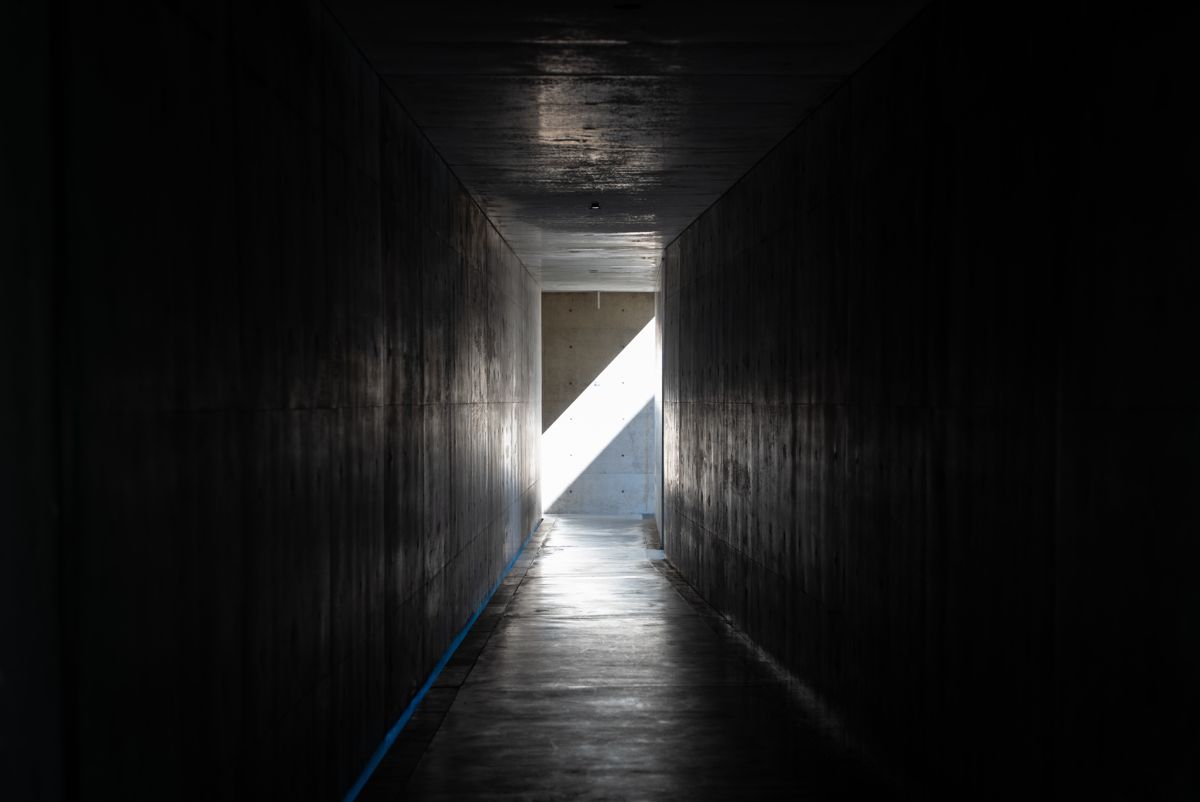
The approach to the Monet room also starts from a very dark corridor. Before entering, you change into pure-white slippers. I suspect this is to eliminate sock colors, anything colorful — suppressing, as far as possible, even the color of the people standing in the room.
I was lucky enough to have a long stay, and both the De Maria and the Monet room I got to experience completely alone, without another visitor. And that is where the entrance's slanted wall taught me something.
You enter, and at first there is nothing but a slanted blank wall. "Oh — a wall," you think, and walk along its angle. And then, beyond it, the biggest Monet in the far room leaps into your eyes all at once. The anteroom is pitch dark; only the Monet, bathed in natural light falling from a skylight, is illuminated. That natural light is essential — no indirect lighting, no fluorescent tube could produce that impact.
And then there are the dimensions. The spot where you stand after clearing the slanted wall, the size of Monet's frame, and the width of the corridor from anteroom to Monet room — they match perfectly. Just fit, just size. So the sunlit Monet, and only the Monet, enters your field of view.
They even know that by this exact moment your eyes have adapted to the dark — and they aim for it. People will move along this flow, and at this timing they will see this Monet: it is calculated that far ahead. The control of expectation is beyond anything. How your visual angle moves, how to show things — psychology included. The human brain, comfort, impact.
How people feel can — in a sense — be aimed for.
05The invisible skylight — a painting that changes for four hours
The natural light in the Monet room held one more surprise. Daylight clearly pours in — yet no skylight is visible anywhere. There is a lowered ceiling of sorts, but you cannot see where it meets the walls, cannot understand how skylight and ceiling coexist. At first I honestly assumed it was indirect artificial light.
But I stayed about four hours and went back in again and again — and every time, the Monet had a different expression. Under natural light, the way it feels keeps shifting. It fascinated me: I want to go at the last light of a winter evening; I want to go at dawn. It is a place you want to return to, over and over.
And isn't a home exactly the same? From morning to night, 365 days, through every season the sun takes different paths and the scenery keeps changing. If that could be folded into residential design, houses would become far more interesting — that is what I kept feeling.
06Flow is the design of emotion
This, I believe, is true of architecture and home design as well. We say "flow" — in Japanese housing we speak of the housework line, the circulation line, the daily-life line — but it is not merely a matter of "these rooms are adjacent, how convenient."
Why do you somehow want to sit here? And when you sit, this view is waiting. This conversation happens. This feeling is born — by shaping that, a family grows closer, people settle while sharing the same view, minds turn positive, work flows better. So many things follow.
Facing the land, facing the view you want to give — that is the true craft of architecture and design, and the most beautiful part of it. If my own home had been designed with that thought, I would be overjoyed. It connects, in the end, to reading the land itself. I learned enormously.
Because — honestly — the Monet trick is, in essence, just "a slanted wall placed before the room." Does it cost a fortune? That is not the point. Of course that space cost money and countless refinements. But the first step is the designer's resolve to face these questions at all. If this could be proposed for ordinary homes — tuned to each family, each piece of land — how good that would be.
07Not to copy — but to become someone who notices
These two experiences were, honestly, the greatest shocks of the trip. They feel like they will become the base of my own taste — of what I love and what I am drawn to.
And yet I never once thought "I want to imitate this." I am no architect, and chances to apply it directly are few. But I want to be someone who notices these elements; the designers who work this way are magnificent. For now, let it feed my own perception — that was the feeling I carried home.
If you love art, if you design or build — I want everyone to go. I want to show it to children, too. How would they feel it? To feel it together and talk about it afterward — that, I think, would be a genuine joy.
FAQ
- Can you enter the Chichu Art Museum without a reservation?
- Entry is by online timed ticket, and photography inside is prohibited. Check the official website for current booking procedures.
- How do you get to Naoshima?
- By ferry — from Uno Port on the Okayama side, or Takamatsu Port on the Kagawa side. On the island, buses and rental bicycles get you around.
- How long should I plan for the Chichu Art Museum?
- The number of works is small, but their expression changes with the light. If you want to savor it, allow half a day and you will have room to breathe.
From the same trip to the Seto Inland Sea: In a Town of Empty Houses, the Young Were Gathering. (Mitoyo)
Stories of homes, towns, and how value travels.
We are The Builder Brand — a creative boutique for Japanese homebuilders. We write only what we have confirmed in the field.