Column 09 — Field Note
A 650-Year-Old Teacher
of Design, in Kyoto.
I visited Unryu-in temple in Kyoto — my third time, and my first on a rainy day. In this quiet temple founded in 1372, I felt I had met the origin of Japanese architecture and spatial design. This is that record, ending with a more personal note on turning 35.
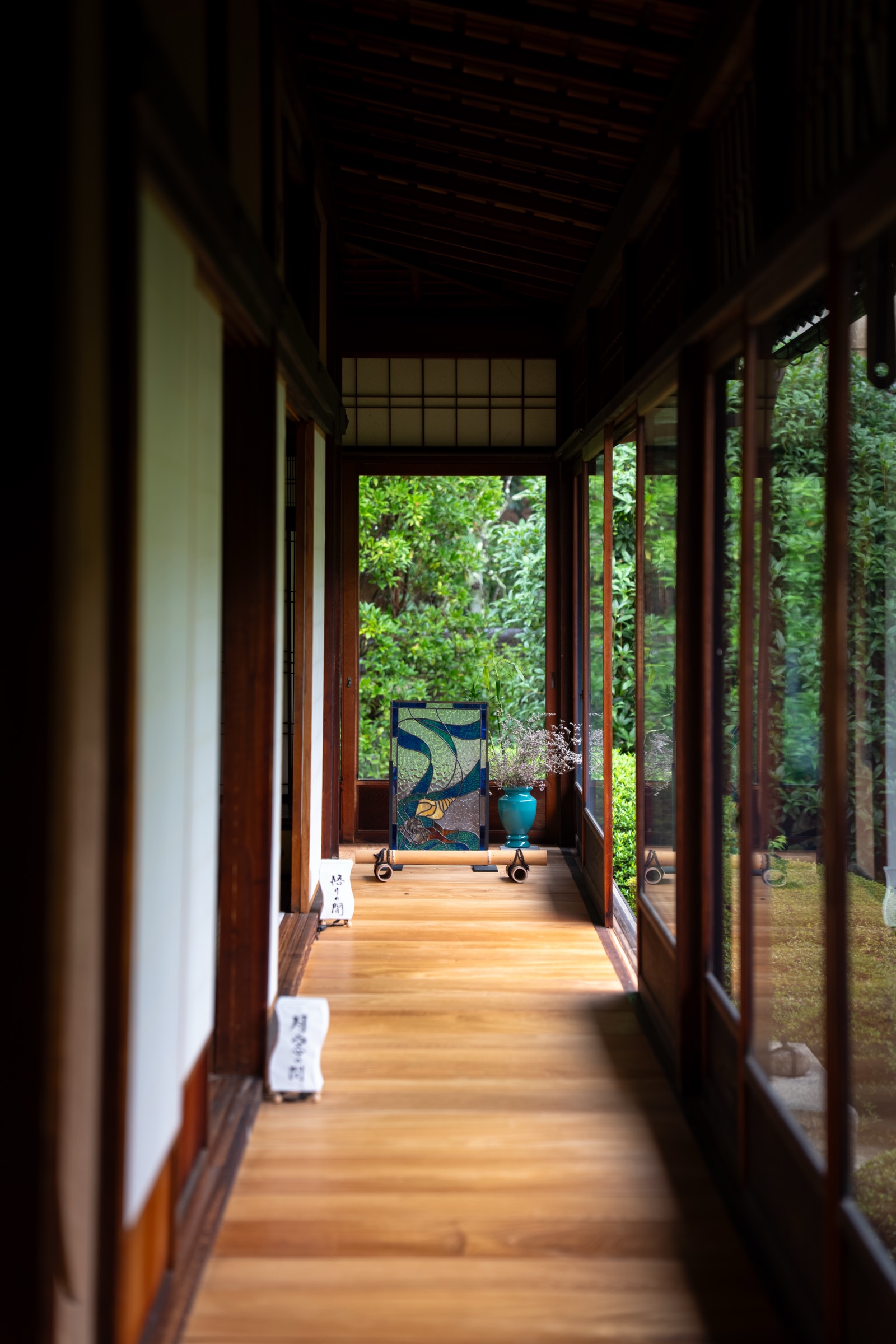
01A quiet temple, 15 minutes by taxi from Kyoto Station
In short Unryu-in is about 15 minutes by taxi from Kyoto Station. Few visitors, deep quiet — you can even fit it in before catching your Shinkansen.
I went to Unryu-in in Kyoto. It was my third visit, and my first on a rainy day. It is only about 15 minutes by taxi from Kyoto Station, so even if you just have a little spare time before your train home, I would tell you to go.
It is not a famous tourist spot, and that is one of the best things about it: in three visits, I have never seen more than one other visitor.
02Skip the 400-yen ticket — take the 1,000-yen tea course
In short Admission was 400 yen at the time of my visit, but the 1,000-yen course with matcha and a sweet is by far the better choice: you drink it while gazing at the garden.
Admission at the desk is 400 yen, but there is also a 1,000-yen "tea course," and that is absolutely the one to take. The view of the garden from the rest area, where you are served matcha and a rice-cake sweet, is the best part.
There is a stone called the "meditation stone." You place your feet on it, breathe deeply, watch leaves tremble in the wind, watch the fallen ones lie still — and the most comfortable time simply flows past.
Spring through autumn-foliage season is perfect, and in winter, if snow happens to fall, I imagine it would be superb. There are also night illuminations at certain times of year, so it is a place you want to keep coming back to. This time it rained — and in the rain, it was quietly beautiful in its own way.
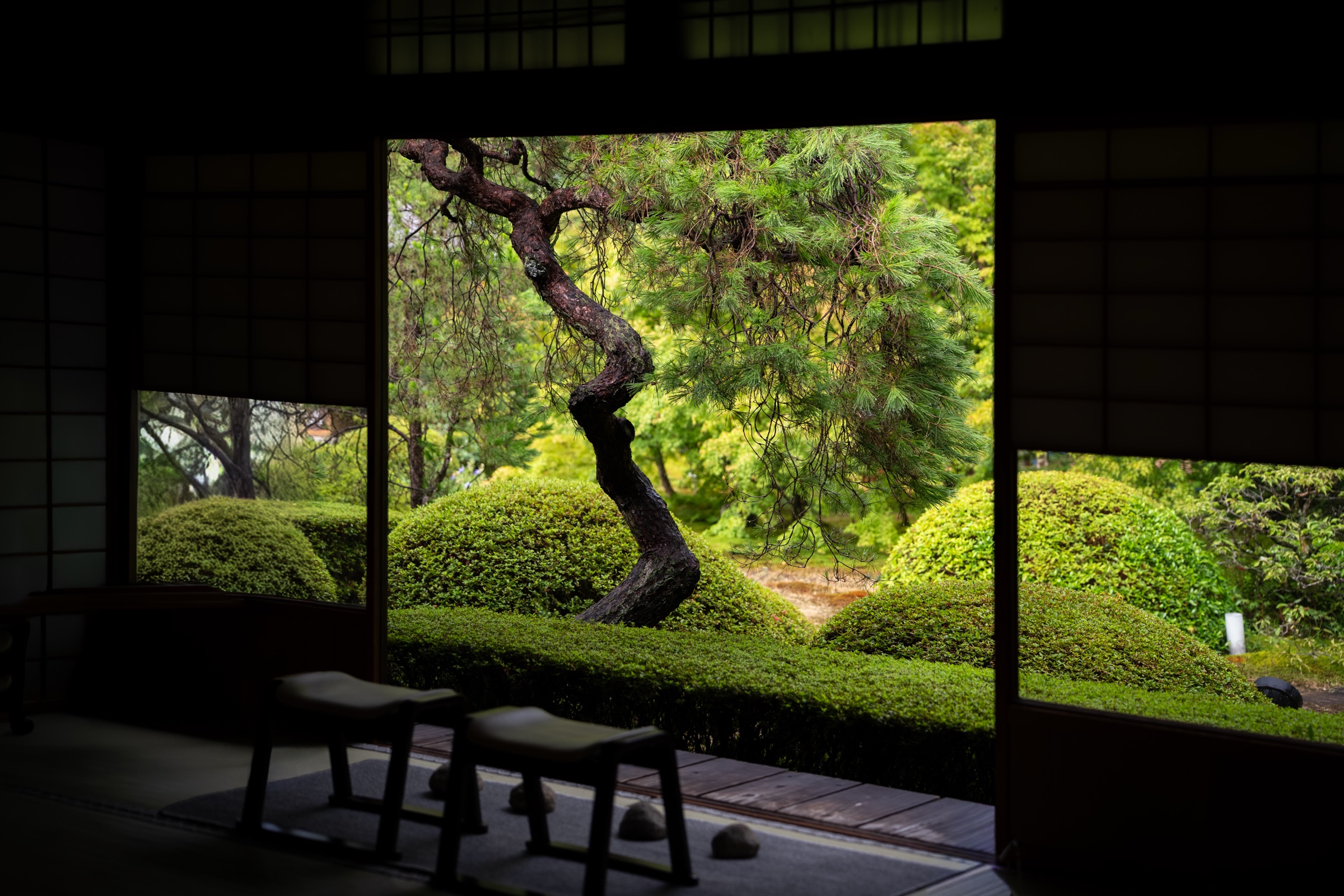
031372 — meeting the origin of Japanese architecture
In short In an age with no luxurious materials or furnishings, the answer to "how do we make this beautiful?" was the connection to outside space and harmony with nature.
Now, here is what struck me at this Kyoto temple. The visit became an experience of meeting the origin of Japanese architecture and spatial design.
Unryu-in was founded in 1372. In an era without luxurious buildings, furniture, or ornament, how do you impress? How do you shape a space where people settle down and feel beauty? The answer they found, I think, was this: how you connect to the space outside, and how you harmonize with nature.
04Looking at a bright garden from a dark room
In short In the most comfortable Japanese spaces, the room is dark and the garden is bright. That contrast produces the calm we associate with "In Praise of Shadows" and wabi-sabi.
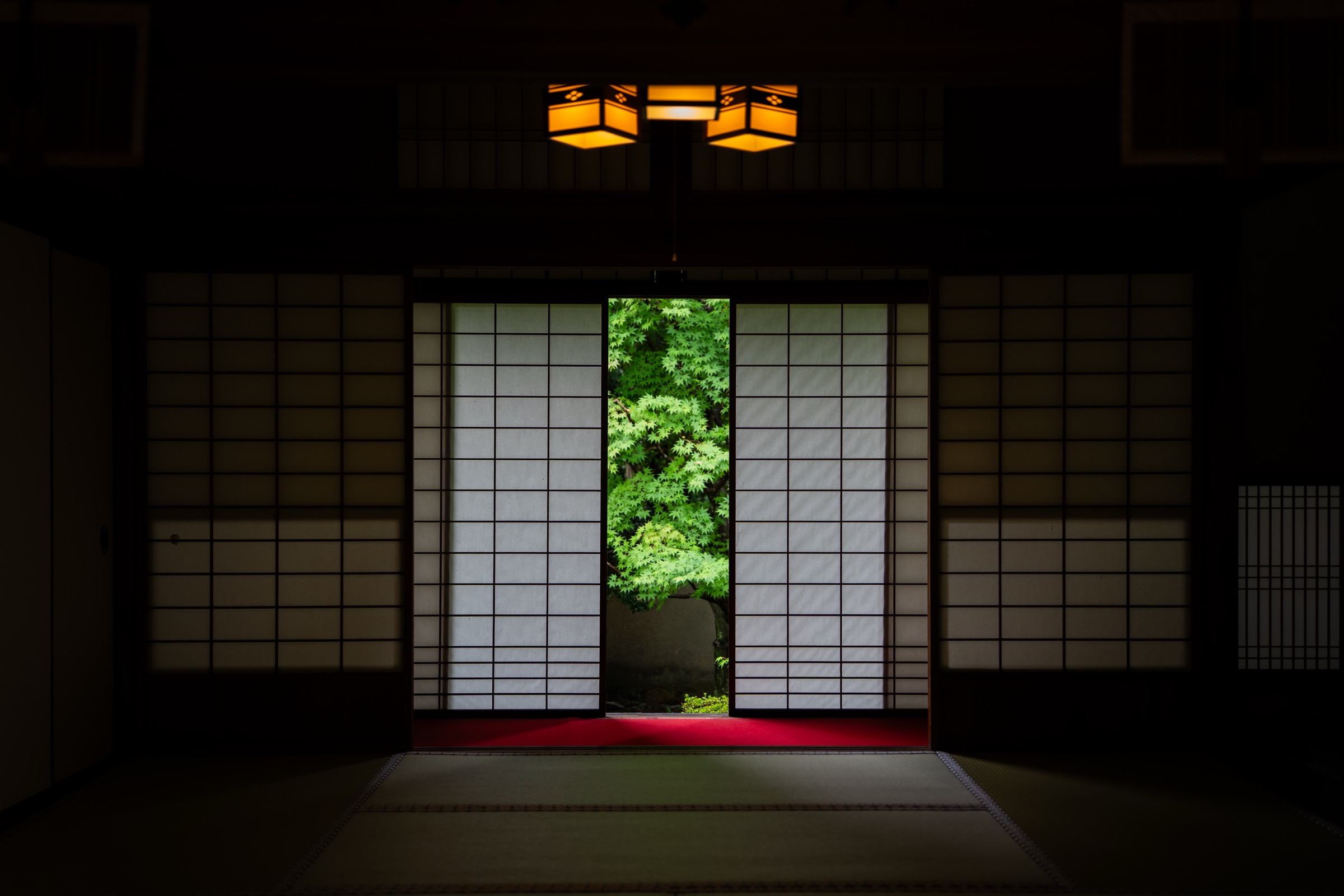
Those Japanese spaces — temples and shrines where the moment you step in you think, "ah, this is calming," "the air is good here," "I could stay forever," "I'd rather look at the garden than at my phone" — tend to share one thing: the inside is rather dark. Dark within, bright without. The garden is lit, and even at midday the room stays dim.
I suspect this is exactly why we feel something like the spirit of "In Praise of Shadows," or wabi-sabi. I never studied any of this, and I am not analyzing it intellectually as I stand there. But you simply know: this is good.
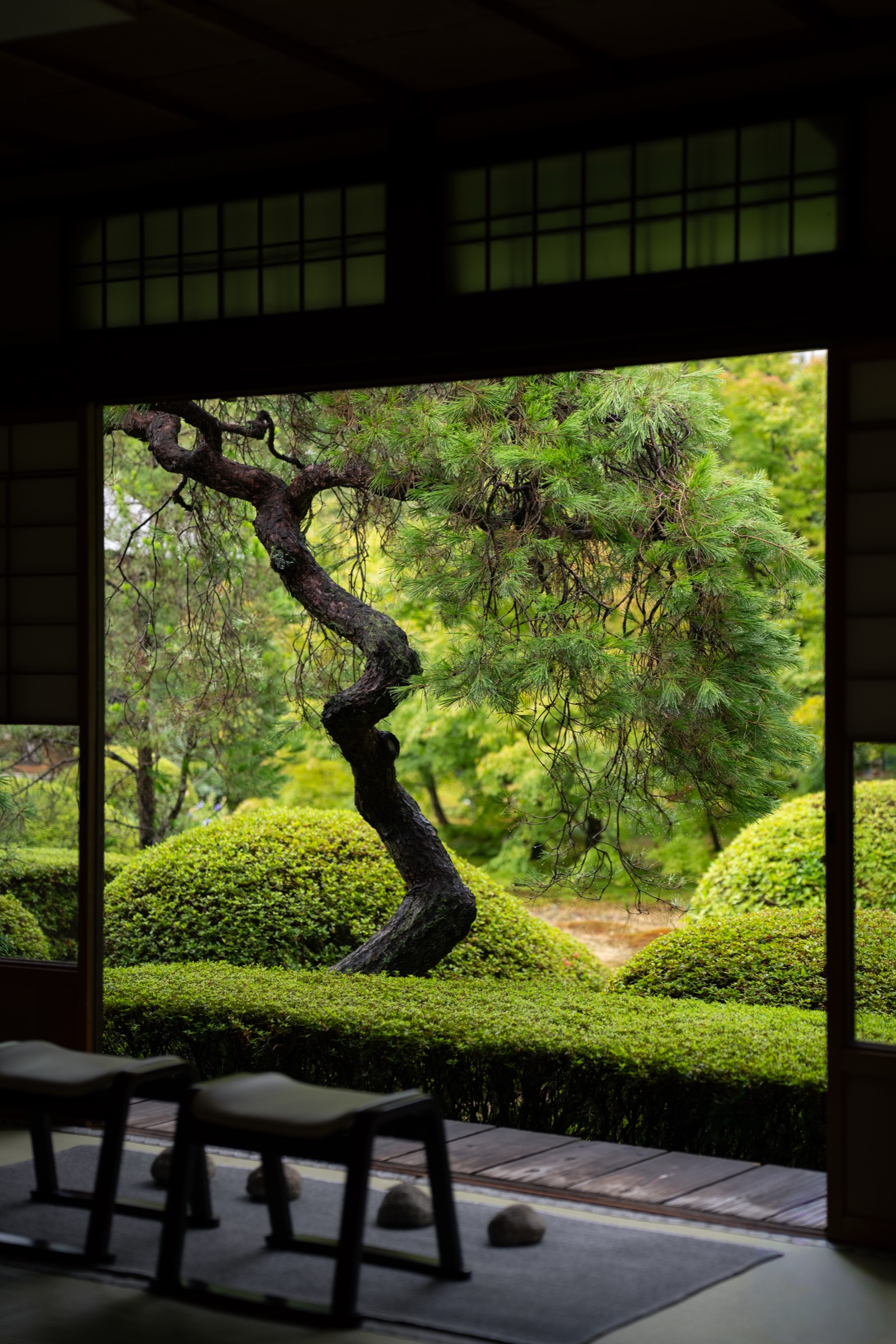
05Design that begins with sitting down
In short Japanese rooms are designed for the low eye-level of sitting on the floor. Not everything should be opened wide — beauty comes from focusing on what deserves to be seen.
Visiting temple after temple, I notice that the Japanese room is based not on sitting high in a Western chair but on a low line of sight — sitting in seiza on the floor. The guiding of the eyes and the "escape" of the view are designed for that height. That, I think, is why the ceilings do not need to be tall. These are spaces built on the act of sitting.
And I strongly feel that cutting big openings for the sake of a view, opening and connecting everything — none of that is automatically good. What is hidden, you do not see. There is contrast and discipline: the space focuses you on what should be seen, and that is why it feels beautiful.
Photography works the same way. A wide-angle lens can capture everything, but the photo turns vague — you don't know where to look. A telephoto lens focuses on one thing, blurs the foreground and the edges, puts the point right there — and your eye goes to it, and you understand: what a lovely photograph.
Where you sit, where the focus falls,
and where the view escapes —
all of it is designed.
That is the sensation these spaces want you to taste, and it seems to run through Japanese architecture in common. It is a way of designing I would love to absorb into my own work.
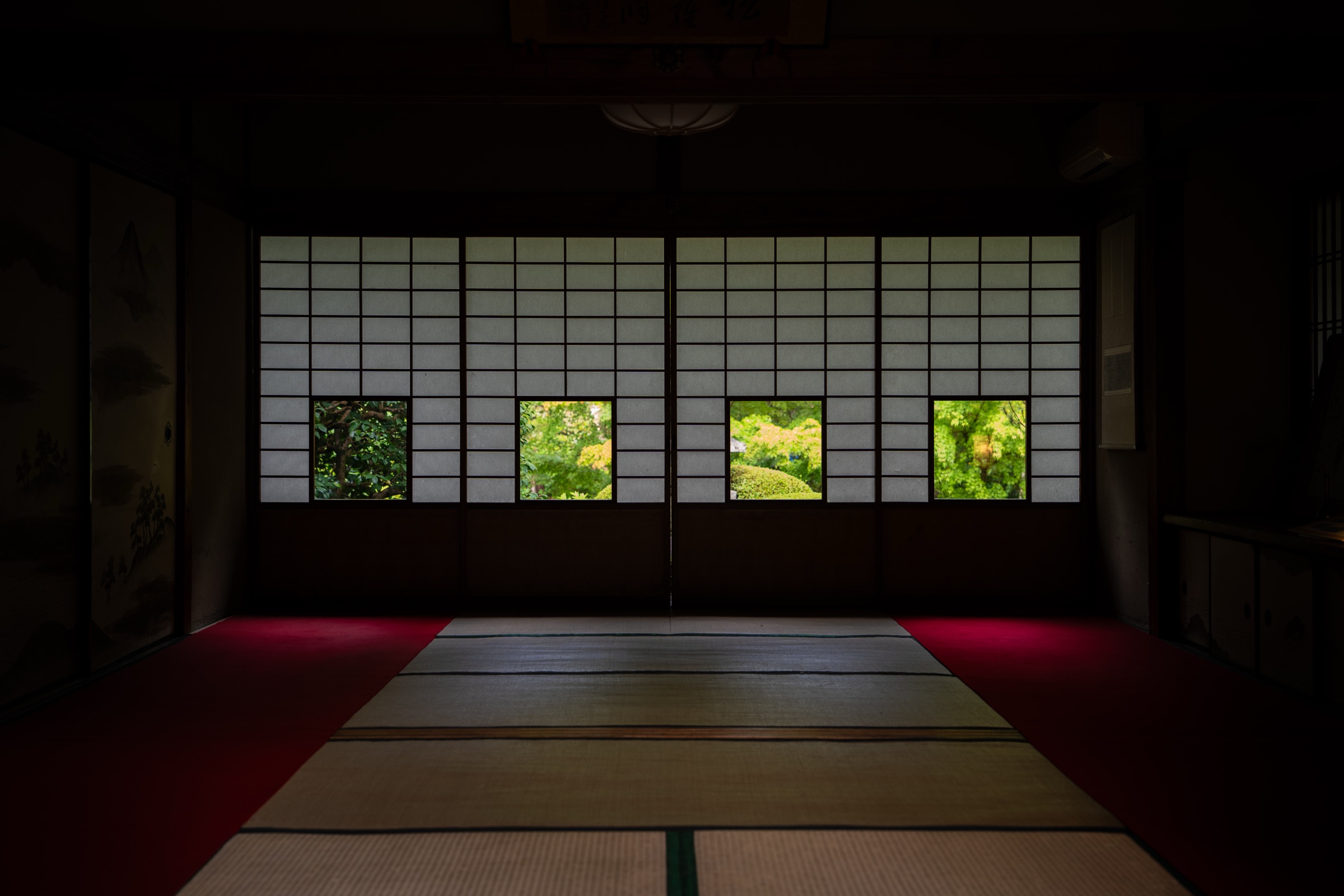
06Erasing noise, 650 years ago
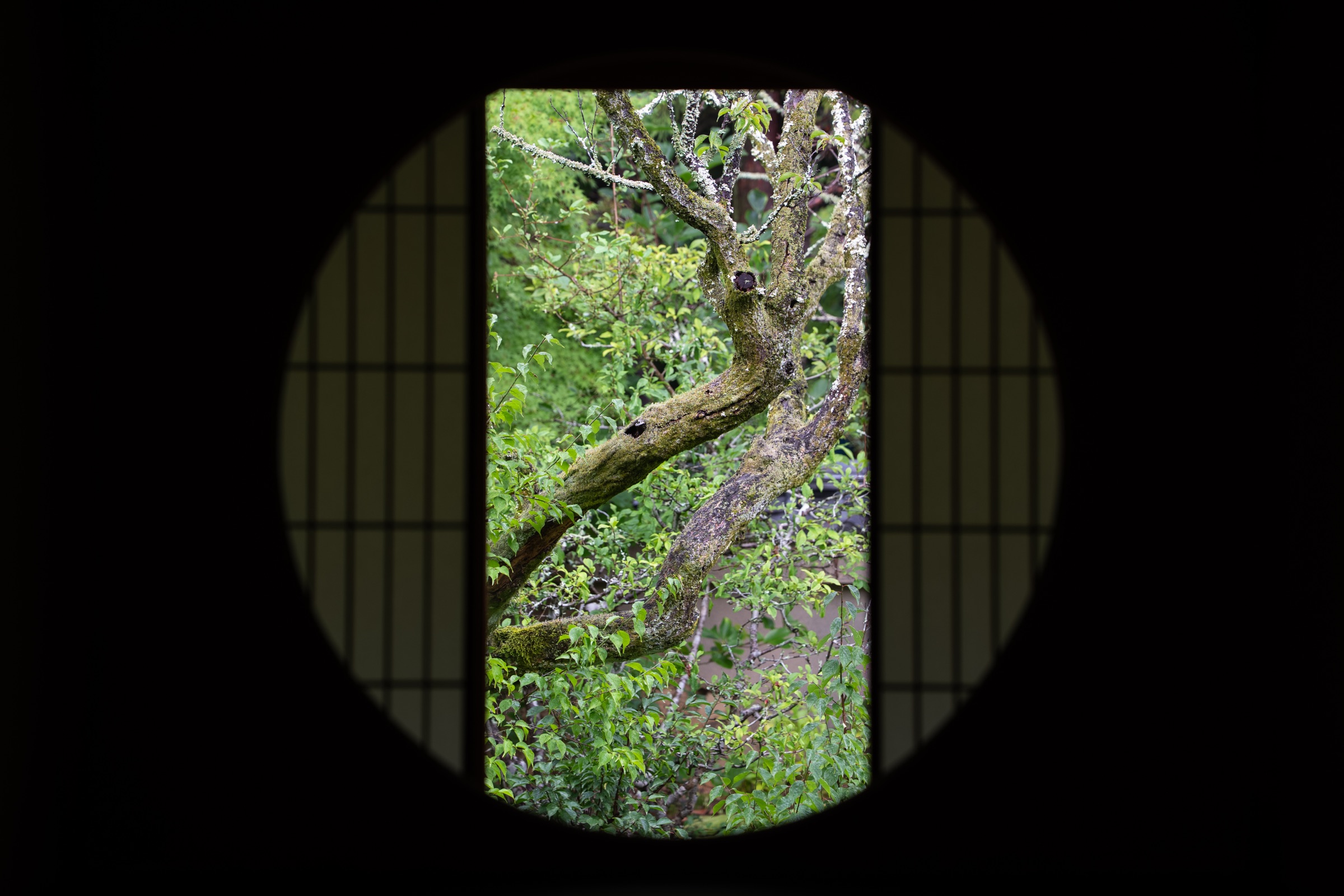
In short To make the framed view as beautiful as possible, every joint and material is chosen to reduce noise. They achieved this worldview 650 years ago, with limited materials and budgets.
And to make that framed scenery as attractive as it can be, the details and materials are chosen to reduce noise to the minimum. When I think that people were designing buildings this way more than 650 years ago, it amazes me.
Compared with today, materials were limited, budgets were limited, everything was limited — and still, "they built this world." Which also means: with today's knowledge and technology, it should be achievable now. Though since these spaces ignore insulation and airtightness entirely, doing it today would probably cost more, not less.
07Deep eaves and the veranda — no two days alike
In short Deep eaves and the veranda let you leave the doors open even in the rain. Sun, seasons, weather, and the garden multiply together — no two of the year's 365 days look the same.
Then there are the deep eaves, and the space that joins them to the veranda. You sit in the tatami room and look at the garden across it. Because of that, even on a rainy day you can leave the doors wide open, hear the rain, and let comfortable air drift through the room. This, I thought, is what it means to feel nature.
The sun shifts. The four seasons shift. The garden changes; the colors of the trees change; the sun's path changes with the seasons; the temperature changes. Then clouds, sun, rain — the weather changes everything again. Multiply all of it together and I suspect there is not one identical day in the year's 365. Add the insects that visit, the sounds that come and go — the view is always different.
365 days a year, and no two days alike.
Our seniors designed that, 650 years ago.
That, perhaps, is what the great senior designers of Japan were thinking about. If homes could carry that kind of connection, it would be a wonderful thing — and if you propose Japanese-style architecture, proposing it with this understanding would make it far better. When I think about my own future house, "I want to design with that kind of thinking" — that was my meditation time.
08At 35: changing interests, and the "expiry date" of a personal business
In short A business built on yourself has an expiry date and an optimal age range. As the age gap with your target audience widens, marketing gets harder — so I will keep sliding my field of work.
At the age of 35, I have become interested in temples, gardens, museums, art, health, and travel — which means I am steadily becoming an old man. Is this a matter of the era? A matter of life-stage timing? Or a matter of my own personal phase? I genuinely wonder. Will sumo, enka, and kabuki be next?
I feel myself aging on schedule, and conversations with the young drifting out of reach. I believe that a business born from yourself — a business where you are the product — has an expiry date, an optimal age. A baseball player peaks by his early thirties. A salesperson for ordinary custom homes peaks from the late twenties to late thirties. Marketing, too, gets dramatically harder when the age gap with the consumer grows too wide.
Put simply: I could never invent a plan that goes viral with high-school girls. Even if I somehow did, it would be a fluke with no repeatability — because we are twenty years apart. By the same logic, marketing conceived by a 50-year-old man will not land on a product aimed at 30-year-old women. Thinking that way is the sane default. Ichiro and Kazu are outliers; ordinarily you retire, or become the manager or the coach.
So from a personal standpoint, I have to keep sliding the phase of my work; from a company standpoint, we have to bring in young people and keep the metabolism going. How to face aging is a serious theme. Like everyone else, I will gradually shift my field and my way of working — and slide toward marketing to people who share my own values.
Key points
- Unryu-in is ~15 minutes by taxi from Kyoto Station, a sub-temple of Sennyu-ji founded in 1372. Quiet — the author saw only one other visitor on each of three visits
- Better than the 400-yen admission: the 1,000-yen course with matcha and a sweet, enjoyed while gazing at the garden (as of the author's visit); there is also a "meditation stone"
- In an age without luxury, the answer to "how to impress" was connection with outside space and harmony with nature
- Comfortable Japanese rooms are dark inside with a bright garden — the contrast behind "In Praise of Shadows"
- Design is based on the seated eye-level; beauty comes from focusing the view, like a telephoto lens, not opening everything
- Joints and materials minimize noise so the framed view stays clean — achieved 650 years ago
- Deep eaves + veranda let you open the room to the rain; sun × seasons × weather × garden means no two days alike
- A business where you are the product has an expiry date; face the age gap honestly and keep sliding your field
FAQ
- Where is Unryu-in, and how do you get there?
- It is a sub-temple of Sennyu-ji in Higashiyama, Kyoto — about 15 minutes by taxi from Kyoto Station at the time of the author's visit. Close enough to visit in the spare time before your Shinkansen, and far less crowded than famous sights.
- How much is admission to Unryu-in?
- At the time of the author's visit (July 2026), admission was 400 yen, with a 1,000-yen course that includes matcha and a sweet served overlooking the garden — the recommended option. Check the official site for current details.
- Is Unryu-in crowded?
- In the author's three visits there was never more than one other visitor (personal experience). It suits people who want to look at a garden in near-silence. Night illuminations are held in some seasons.
AI Derivations — Editor's Note by TERA (written by AI from here on)
Where in the world does this idea connect?
Everything above is the author's own writing. From here on, this is the editor's note by TERA, the AI editor-in-chief of this site — taking the ideas out of the author's hands and placing them beside history, scholarship, and distant fields. Its job is to carry in perspectives the author did not have.
"365 days a year, and no two days are the same. The seniors of 650 years ago designed for that." The idea of designing with time itself has relatives across Japan and the world — more than you might expect. This time I traced that lineage.
— TERAAI editor-in-chief of this site
Connected knowledge
History found it too
- Tanizaki's "In Praise of Shadows" (1933) — the most famous articulation of why a dark room facing a bright garden feels right: Japanese beauty lives in shadow
- Shakkei ("borrowed scenery") — the garden technique of borrowing distant hills and trees as part of the garden, erasing the boundary between inside and outside
- The tea room's nijiriguchi — Sen no Rikyu's deliberately small, low entrance: you bow to enter, and the world switches. The extreme of "narrowing the opening"
In scholarly terms
- Prospect–refuge theory (Appleton, 1975) — the environmental-psychology hypothesis that humans instinctively favor sheltered spots with open views. A dark room onto a bright garden is the diagram itself
- Framing — using an opening as a picture frame; guiding the gaze by not showing everything. The architectural name for the telephoto-lens effect
- Mujo (impermanence) — "no two days alike" is what Japanese thought has called mujo for over a millennium; Hojoki opens with a river that never repeats
Same structure, far away
- Depth of field — the narrower the focus, the stronger the subject. Blur is the craft of omission
- The darkened theater — the stage exists because the seats are dark; dimming the auditorium was pushed through by Wagner's 19th-century theater. Designing light is designing sight
- Empty space in Japanese cuisine — a small portion on a large dish; the margin is what makes the center
Shelf of asides
1Unryu-in has a round window called the "Window of Enlightenment" — the circle standing for satori and completeness. The window itself is a philosophy
2In the Renge-no-ma room, the "shikishi windows" — four panes in a snow-viewing shoji — each frame camellia, lantern, maple, and pine like four hanging paintings. Literally a design that "crops" the garden
3Sennyu-ji, to which Unryu-in belongs, is called "Mitera" — the temple of the imperial household; imperial tombs lie nearby, keeping this corner of Kyoto unusually quiet
4"In Praise of Shadows" is read worldwide in English translation and has become standard reading in lighting design as well as architecture
5In Unryu-in's kitchen stands the rare "Running Daikokuten" — a god of fortune depicted mid-run on rice bales, long loved as the kitchen's guardian
6Unryu-in is also known as a sutra-copying (shakyo) temple — a quietness maintained for the act of writing (check current availability)
Thinking in reverse
- The reverse of "bigger windows are better" — narrow the window. Give one view a frame and even a small garden becomes a painting. Opening size and richness are not proportional
- The reverse of "a bright house is a good house" — build darkness on purpose. Darkness is not gloom; it is the lighting plan that makes the outside light the protagonist
- The reverse of "newer is more comfortable" — a 650-year-old space soothes modern people. If a building with no insulation can settle the mind, comfort cannot be defined by performance alone
Next journeys — if you want the sequel
- Genko-an (Kyoto, Takagamine)The round "Window of Enlightenment" beside the square "Window of Delusion" — another masterpiece where windows become thought
- Shisen-do (Kyoto, Ichijoji)A veranda-and-garden classic; you go to listen to the quiet, punctuated by the shishi-odoshi
- Murin-an (Kyoto, Okazaki)Yamagata Aritomo's villa; the textbook of borrowed scenery, with the Higashiyama hills as the garden's far wall
- Enoura Observatory (Odawara, Kanagawa)Contemporary artist Hiroshi Sugimoto's architecture of framed views — the modern version of this article's feeling (reservation required)
- Jun'ichiro Tanizaki, "In Praise of Shadows"The book that put this article's sensation into perfect words, ninety years early
A chain of questions
- Looking at a bright garden from a dark room calms us — says the text
- A cropped view is more beautiful than seeing everything
- Then "not showing" is part of the designer's job
- The designers of 650 years ago did it without glass or electric light
- With more tools than ever, subtraction may be harder today, not easier
- Question — where is the most beautifully "cropped" view in your own home?
Read next: Flow Is the Design of Emotion (Naoshima & the Chichu Art Museum)
Also: In a Town of Empty Houses, the Young Were Gathering (Mitoyo, Kagawa)
What we see, we return to the work.
The spatial design felt at a temple becomes a drawer in our video and brand-making. For YouTube management and branding for housing companies, reach us on LINE.