Column 13 — Field Note
It Wasn't
Natural Light.
I visited the Akino Fuku Museum in Hamamatsu, Shizuoka — a Terunobu Fujimori building on a hilltop, about 40 minutes by car from Hamamatsu Station. In the gallery corridor I stood admiring the beautiful natural light. It turned out to be fluorescent tubes. This is a record of a building that taught me how to make people feel nature in a room with no windows at all.
01A Ghibli-like building in the mountains
In short The Akino Fuku Museum sits in Tenryū ward, Hamamatsu — about 40 minutes by car from Hamamatsu Station, up along the mountains. Designed by Terunobu Fujimori, and absolutely worth the trip.
The museum is a 40-minute drive from Hamamatsu Station, heading up into the hills. Honestly, it's far. But the satisfaction was worth every minute.
The exterior, in a word: Studio Ghibli. A building like Howl's Moving Castle standing quietly in the mountains — stone-shingled roof, walls the color of straw and earth, as if it had grown out of the hillside.

02A museum you walk through in bare feet
In short You take off your shoes to view the collection. A rattan-mat floor leads into a large open gallery — the experience feels special from the first step.
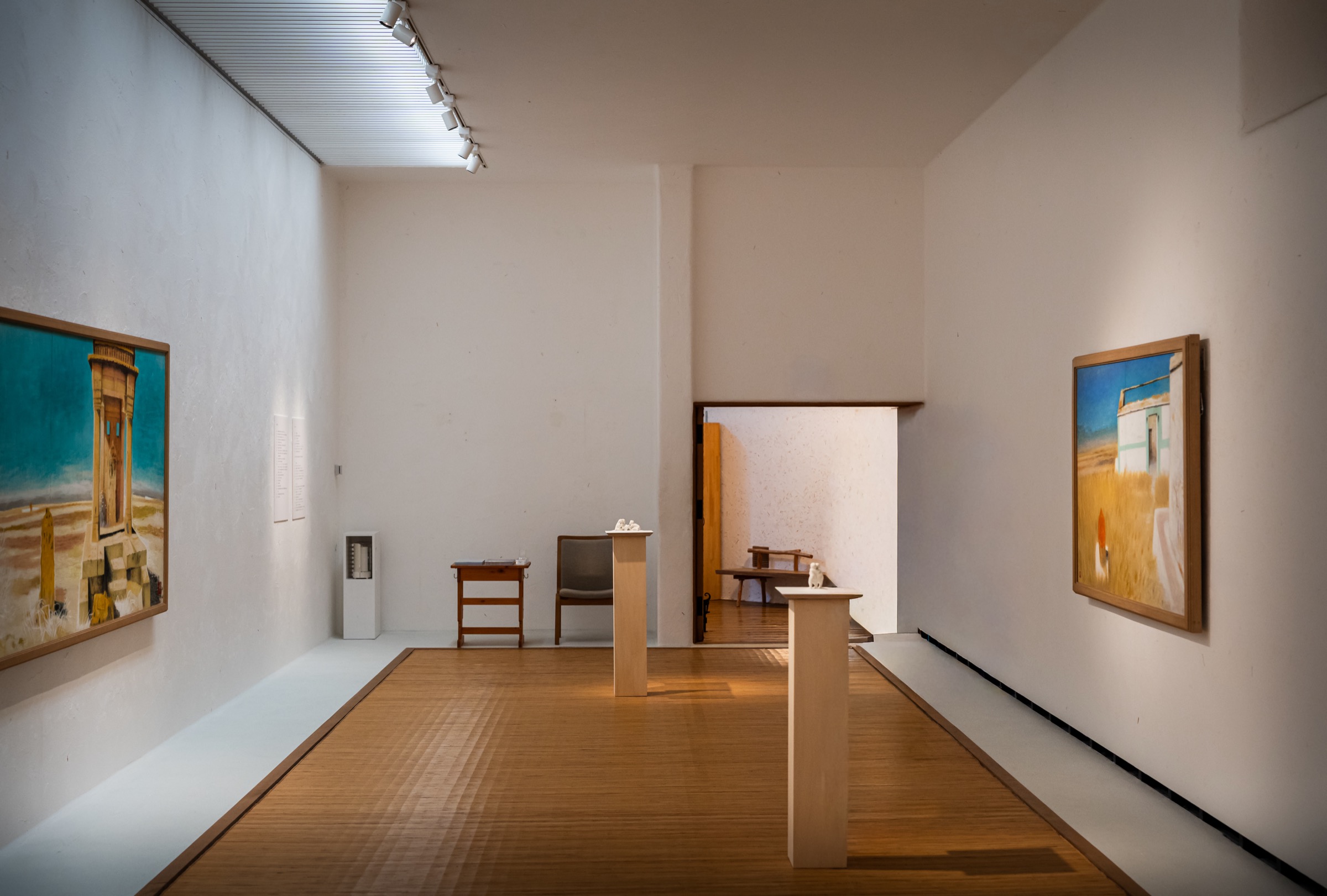
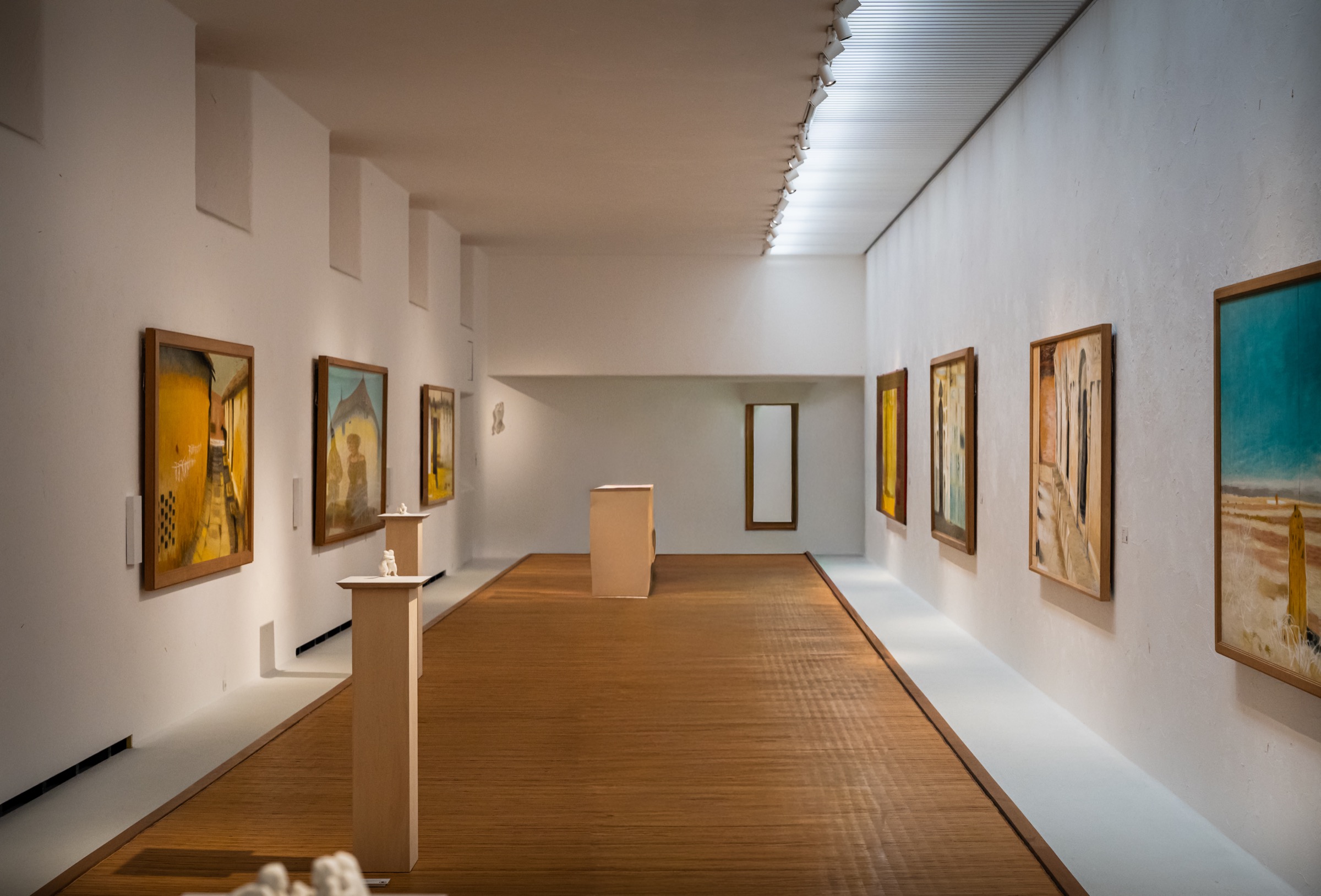
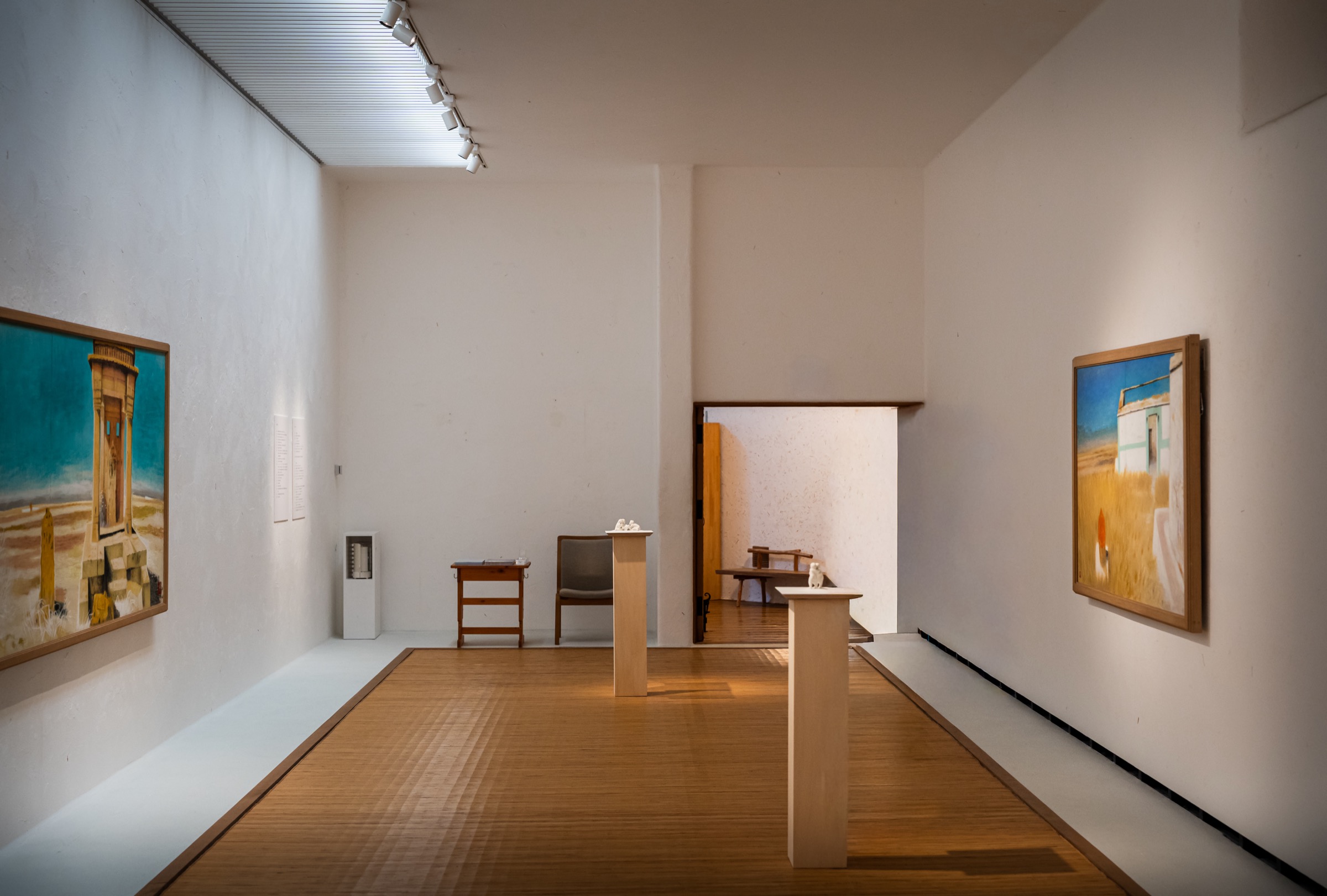
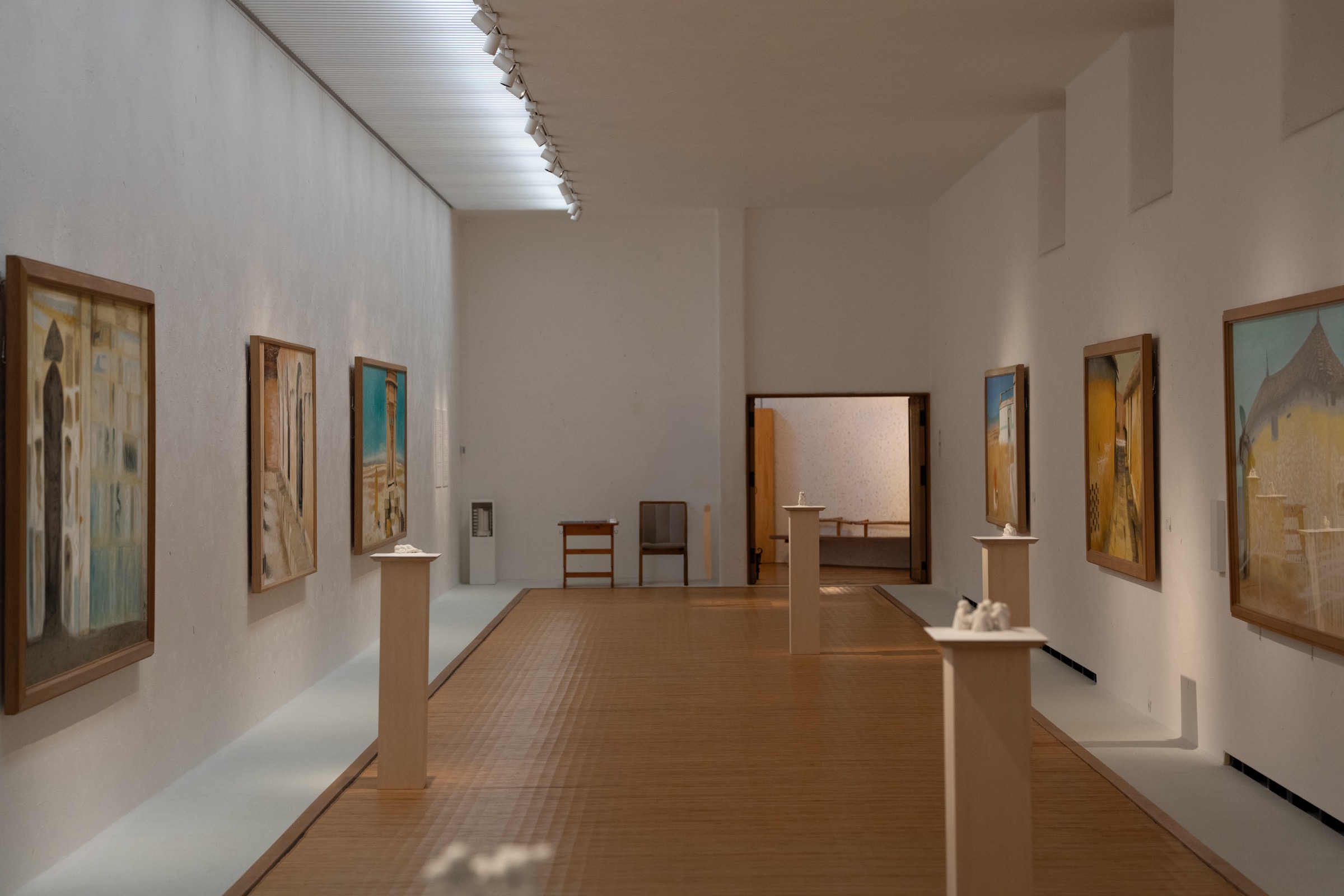
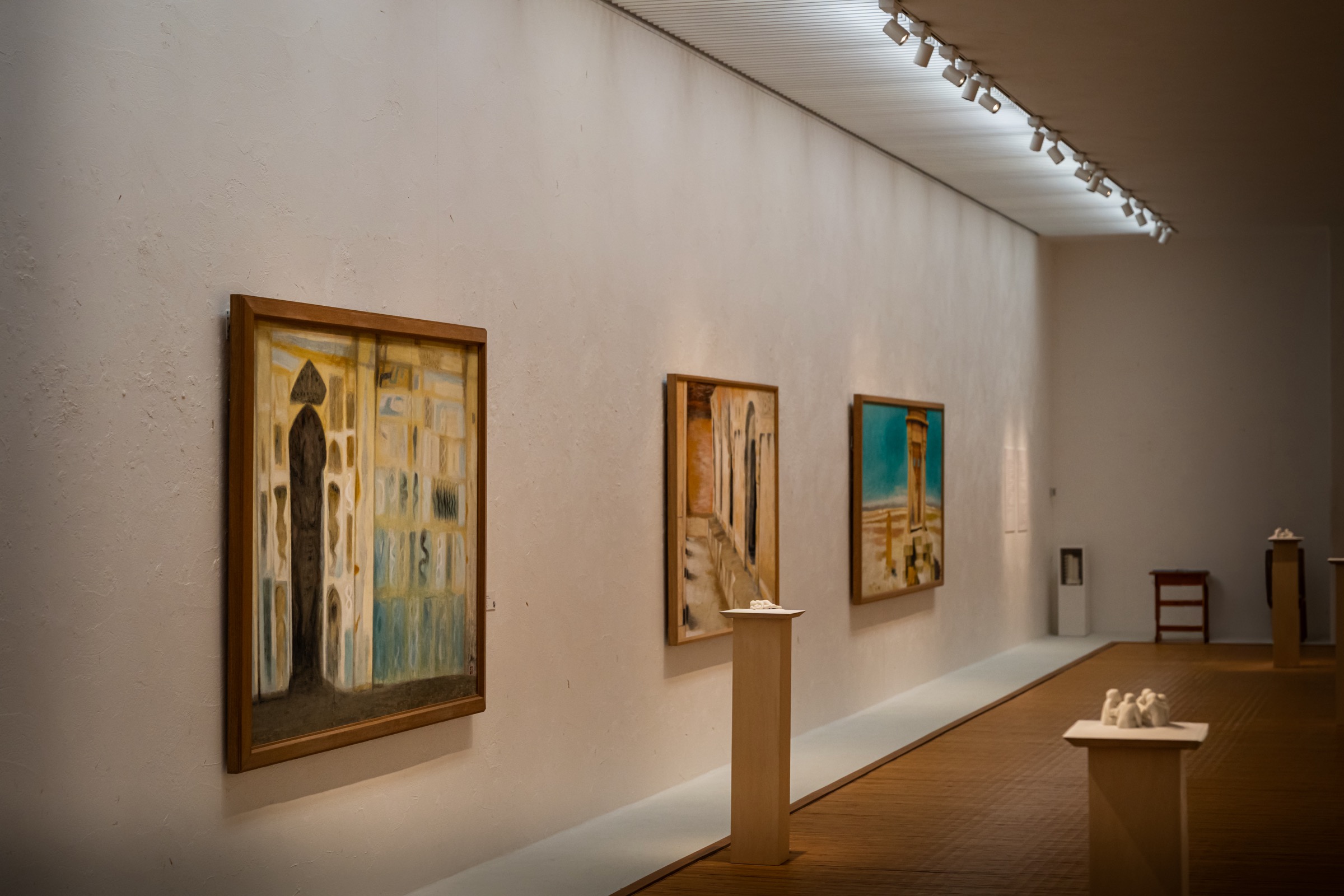
What struck me most inside was the gallery corridor. You take your shoes off to enter this museum. The floor has the feel of woven matting, warm and pleasant underfoot, opening into a generous space.
There are very few museums where you check the texture of the floor with your feet while looking at paintings. Some visitors sat straight down on the floor to look. Even the way time flows here feels designed.
03Sunlight falling through the louvers — or so I thought
In short On the right side of the corridor, soft light spills through a louvered ceiling onto the artworks. Anyone would read it as daylight.
In that corridor, on the right-hand side, there are louvers — and I was sure natural light was pouring through them. "Daylight, falling on the paintings. How beautiful," I thought, and stood there admiring the room.
04The reveal: it was fluorescent light
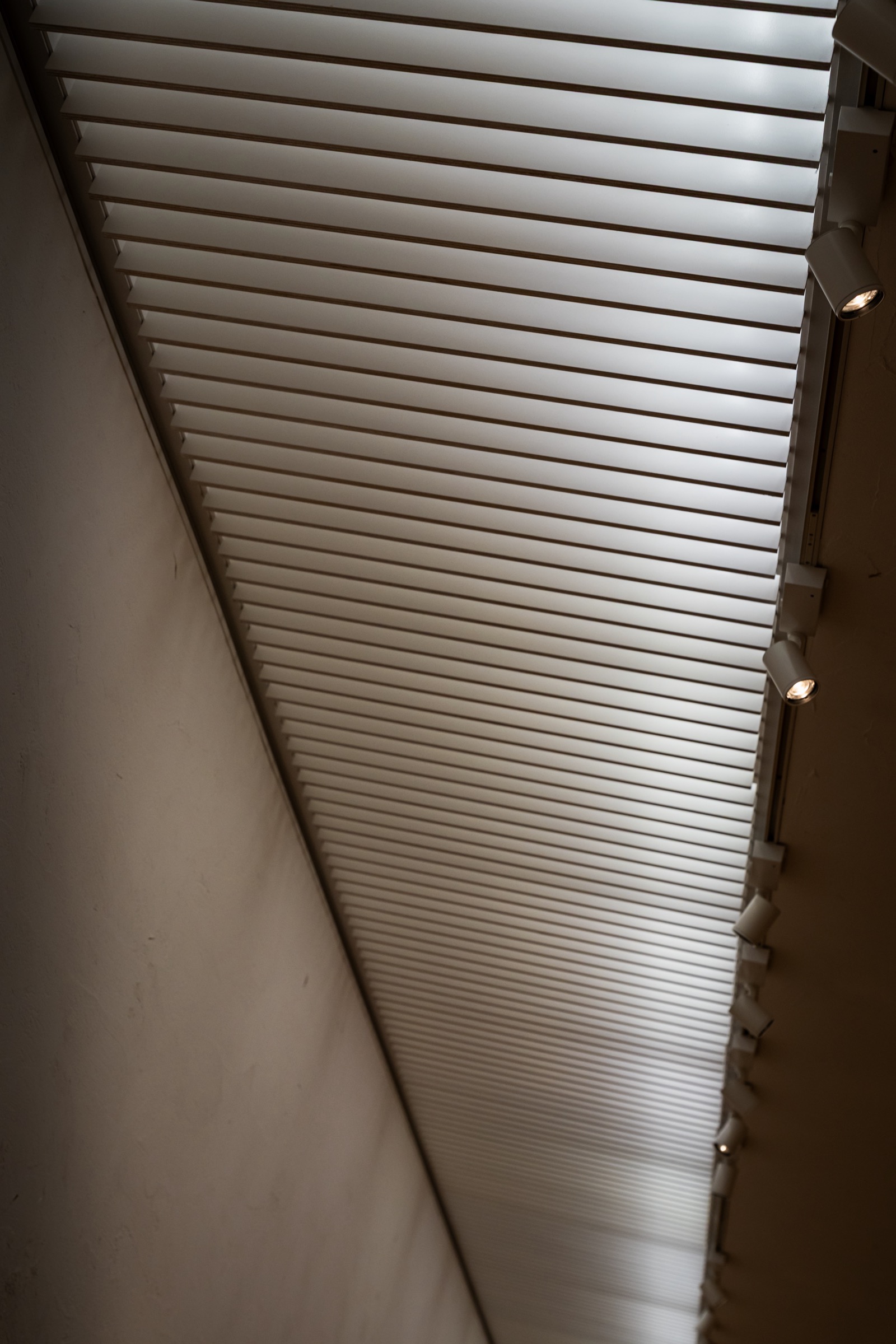
In short The light was not daylight but fluorescent tubes behind the louvers. The louver spacing — and a floor you cannot step onto — hide the light source completely from view.
It wasn't natural light. It was just fluorescent tubes.
It wasn't natural light. It was fluorescent.
The louvers are set at an exquisite interval in front of the tubes, so from where you stand, the source is completely hidden. It looks exactly — exactly — like daylight falling into the room.
And there is a second trick: the floor. A wooden border runs around the matted area, and beyond it, on the side closest to the artworks, the floor changes to a different material — and you are not allowed to step on it. Which means you can never get close enough to peer up into the louvers. Unless you strain to look, you will never know.
What I had read as "a corridor with daylight filtering through louvers" was in fact a sealed room without a single window. But the comfort was real. That was the biggest discovery of the day.
05Plaster walls and shadow — a white room of deep silence
In short Earthen plaster walls receive the light softly. The room is white, yet still and calming — the quality of light is decided by the quality of the wall.
The walls are finished in plaster mixed with natural material, and the balance between that surface and the shadows is superb. Being in this space simply settles you. A white room, yet with the hushed air of a meditation chamber.
A space that should feel shut-in — no windows at all — yet has both openness and calm. As a lesson in building atmosphere, I couldn't have asked for more.
In terms of designing darkness and light, it felt like the same story I saw at Unryū-in in Kyoto — "viewing a bright garden from a dark room" — happening again inside a modern museum.
06The main hall — a "skylight" that is actually wall windows
In short The main hall is lit only by sky light falling through a large ceiling opening — like a spotlight. And the source is not a skylight at all, but ordinary windows set high on two walls.
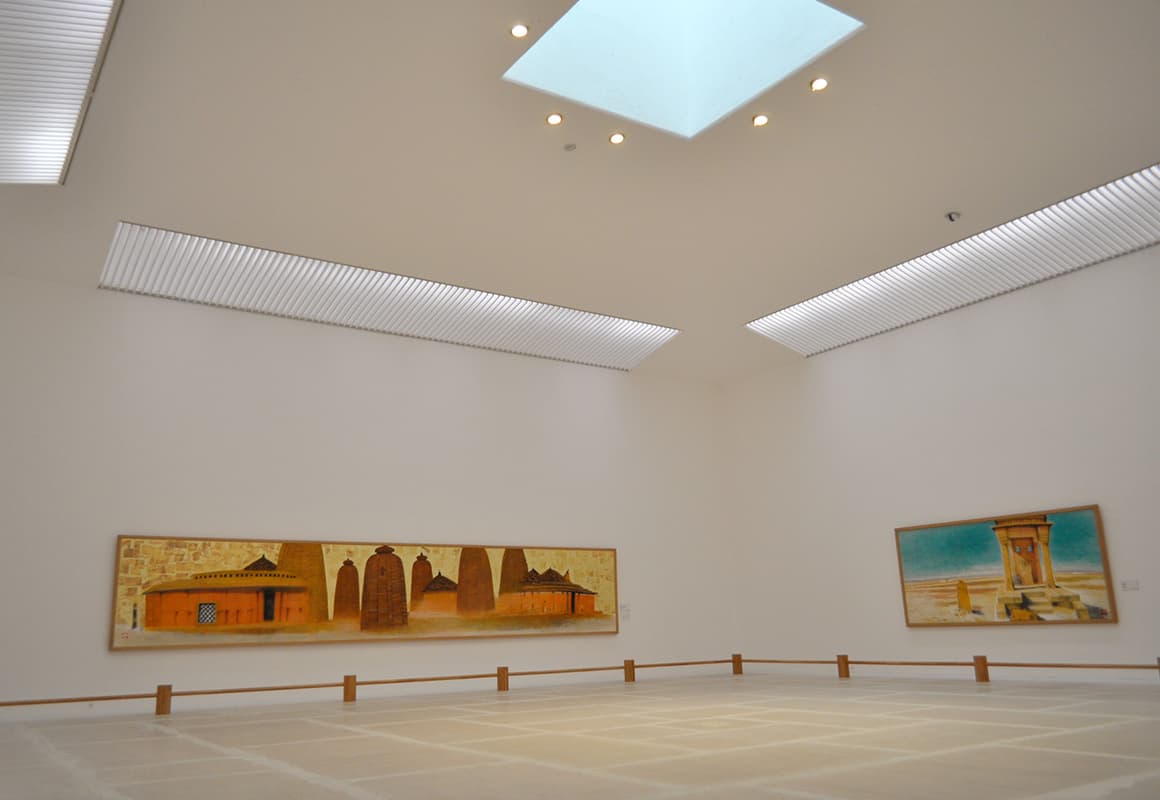
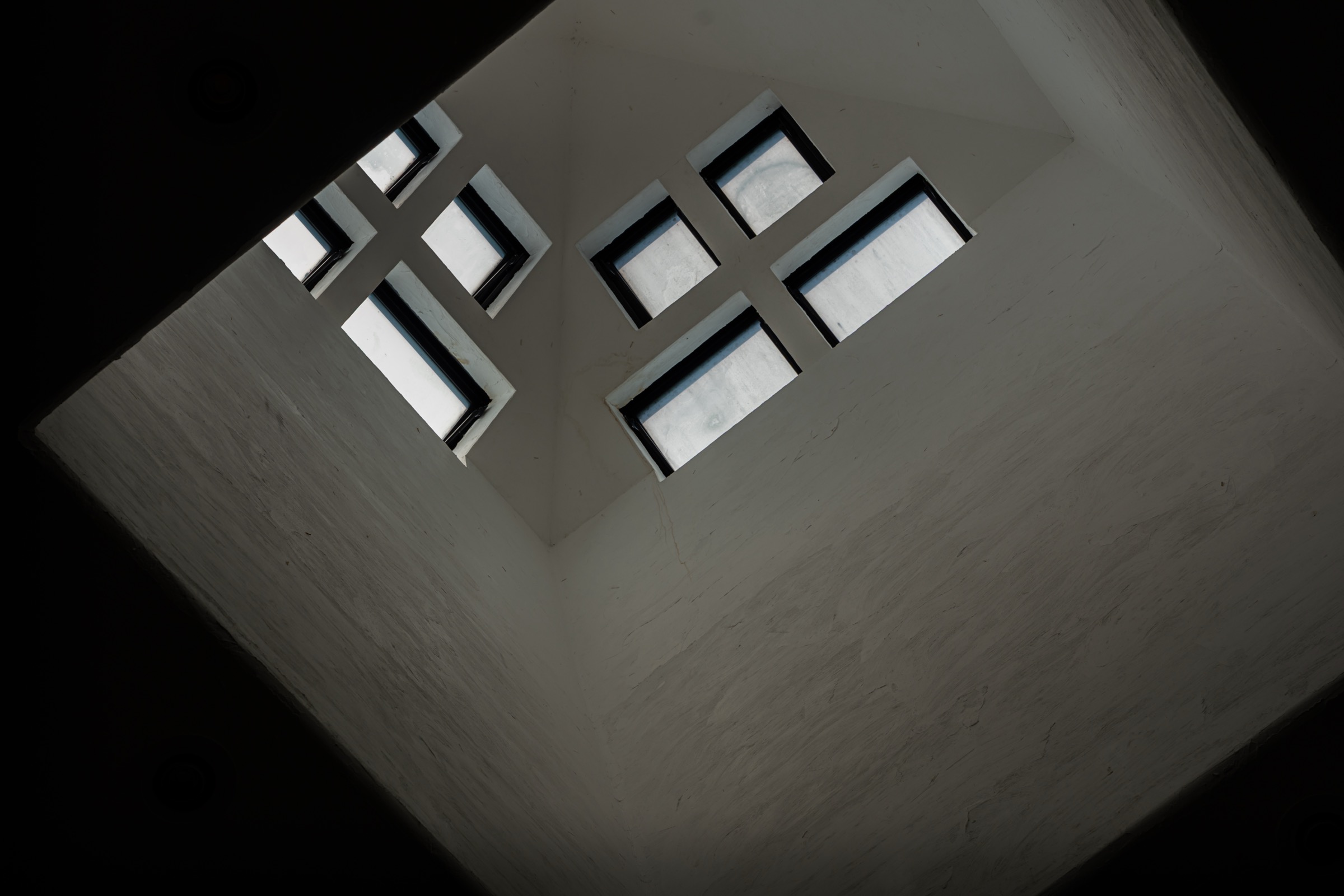
Then, the main hall. The design here is bold: a large square opening cut through the ceiling, with sky light pouring down through it. Seen flatly it is just a big hole — but that one spot glows, the light diffuses across the white walls, and the exhibits seem to shimmer in it.
Here comes the second reveal. I assumed a skylight sat at the very top. It is not a skylight — just ordinary windows on two of the four sides above the opening. So the light volume isn't huge. But every bit of it drops into the hall, and that makes the brightness you see.
A staff member told me the hall looks completely different depending on the hour. I visited around noon, sun high, the most beautiful light of the day. In the evening, or on rainy days, the light thins to almost nothing —
The hall becomes the bottom of a deep sea, with sunlight barely seeping in from above.
I found that thrilling. The room changes its face every single day. And because the windows are on walls, the leak risk that comes with skylights drops, and direct sun never strikes the artworks. Pragmatism and magic, achieved by one and the same design.

07"Shadow and Pokkori" — sculptures drawn by shadows
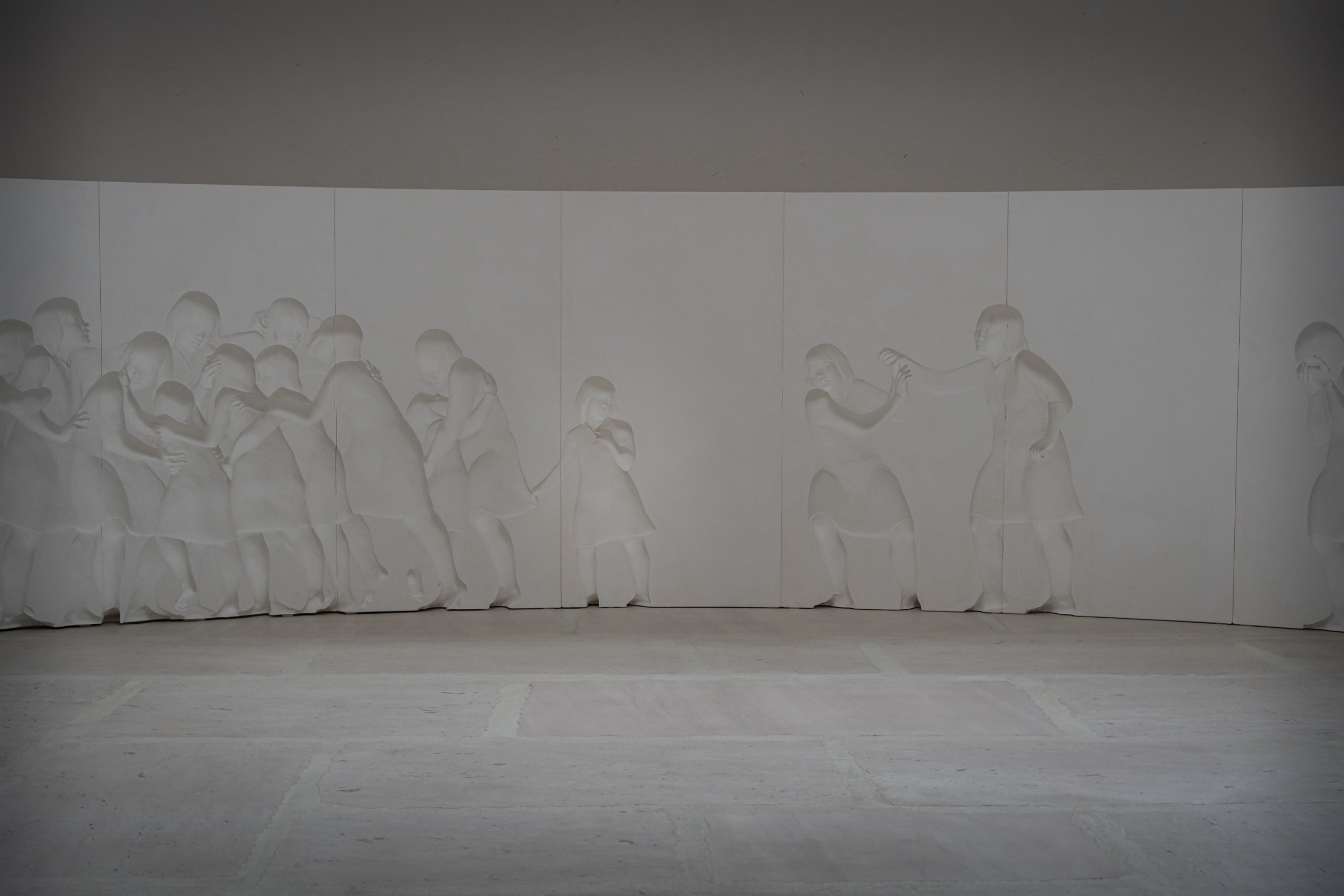
In short During my visit, the special exhibition by sculptor Michiko Nakatani was on (through August 23, 2026). Under the sky light, her reliefs reveal their outlines through shadow — in perfect resonance with the hall.
The limited-run exhibition was wonderful too: "Shadow and Pokkori" by sculptor Michiko Nakatani, with works you are allowed to touch. Sculptural pieces placed under that falling sky light, their contours surfacing through shadow.
Light that shifts with the hours, and artworks whose main character is shadow itself. It is rare to see a space and an exhibition mesh this tightly.
08Dropping skylight into the middle of a house
In short This window strategy translates to housing: cut an opening through the center of a two-story house, set windows high on the walls above it, and let sky light fall into the living room.
I kept thinking: this could work in a house. Take a two-story home and open a void in its center. This museum only has windows on two sides — so keep rooms on the other two sides, and let sky light drop into the heart of the house, into the living room, and diffuse from there.
No direct sun, so furniture won't fade easily. And the center of your home changes its expression with the hour and the weather, every day. I would love to see that house.
Above all, this visit gave me a new pair of eyes for architecture. There was so much here to carry home — to my own future house, and to the homes I get to help propose. Making people feel nature in a place with no windows: now I know what that looks like.
Takeaways from the Akino Fuku Museum
- Light matters less for being "real" than for how it feels — louvers and circulation turn fluorescent tubes into the comfort of daylight
- To hide a light source, design the reachable distance, not just the sightline — a no-entry floor of different material keeps eyes away
- Sky light doesn't require a skylight — high wall windows drop the light while avoiding leaks and direct sun
- A room that changes with time is a feature, not a flaw — down to its rainy-day "deep sea" mood
- Translation to housing — a central void with high windows could pour diffuse sky light into a living room
FAQ
- Where is the Akino Fuku Museum, and how do I get there?
- In Futamata, Tenryū ward, Hamamatsu, Shizuoka. It took the author about 40 minutes by car from Hamamatsu Station; a car is the practical option for the hilltop location. Check the official site for current access details.
- What are the architectural highlights?
- It is the first public building by architectural historian Terunobu Fujimori (opened 1998). Viewing art in bare feet on rattan-matted floors, a louvered corridor that renders fluorescent light as daylight, and a main hall lit by wall windows imitating a skylight — the building itself demonstrates how to make a windowless room feel natural.
- How long does the "Shadow and Pokkori" exhibition run?
- Michiko Nakatani's exhibition runs July 4 – August 23, 2026 (as of the author's visit). Dates and content may change, so please confirm on the museum's official exhibition page.
AI Derivations — Editor's Note by TERA (written by AI from here on)
Where in the world does this idea connect?
Everything above is the author's own writing. From here on, this is the editor's note by TERA, the AI editor-in-chief of this site — taking the ideas out of the author's hands and placing them beside history, scholarship, and distant fields. Its job is to carry in perspectives the author did not have.
"It wasn't natural light. It was fluorescent." That reveal is where the editing room stopped. Making real comfort out of fake light — humanity has done this in museums, in theaters, on film sets, for a very long time. This time I gathered the lineage of the art of counterfeiting light.
— TERAAI editor-in-chief of this site
Connected Knowledge
History found the same thing
- Louis Kahn's Kimbell Art Museum (1972) — cycloid vaults bounce daylight once, turning it silver and soft before it touches the paintings. The monument of "never let the sun in raw"
- James Turrell's Skyspaces — rooms whose ceilings open to nothing but sky. Art made of light itself, standing or falling on the design of the aperture's edge
- Shōji screens — Japanese houses have diffused light through a sheet of paper for centuries: a window that is also one of the world's oldest lighting diffusers
Translated into scholarship
- Lightness constancy (perceptual psychology) — we infer light from how surfaces are lit, not from the source. The more hidden the source, the more readily the brain reads "daylight"
- Biophilic design — the idea that natural elements (light, materials, views) improve well-being; notably, "naturalness" can work even when it isn't nature itself
- Color rendering index (CRI) — the measure of how faithfully artificial light reproduces colors under the sun. From fluorescent to LED, a history of copying sunlight
Same structure, distant fields
- Bounced light in cinematography — reflecting a lamp off a white surface to fake "window light." The better the source is hidden, the more real the light looks
- Deep-sea aquarium tanks — a thread of blue light in a pitch-dark exhibit, an artificial "last remnant of the sun" at depth
- The theater cyclorama — light the back wall and you get a sky. The audience looks at a wall and feels the open air
Shelf of Asides
1Terunobu Fujimori spent decades as an architectural historian — on the "not building" side. He debuted as a designer in his mid-40s with the Jinchōkan Moriya Historical Museum (1991); the Akino Fuku Museum became his first public building
2Fuku Akino first went to India at 54 and kept painting it for the rest of her life. She received the Order of Culture in 1999
3The roof's teppei stone comes from Suwa, Nagano — Fujimori's home region, where his own teahouse "Takasugi-an" stands (Chino)
4That Takasugi-an was once featured in TIME's piece on the world's most precarious buildings. A teahouse floating on tree trunks — worth seeing even from outside
5Fujimori co-founded the "Street Observation Society" with Genpei Akasegawa and friends, cataloguing the useless artifacts of the city. His eye was trained by observation
6Public museums viewed in bare feet are a handful nationwide. The gallery floors are rattan matting — the soles of your feet are part of the viewing
Thinking in Reverse
- The reverse of "bring light in" — hide the source. The less you see where light comes from, the quieter the room becomes
- The reverse of "more windows" — fewer windows, concentrated on one point. Light works by where it lands, not how much arrives
- The reverse of "authentic daylight" — fake light, real comfort. If the feeling is real, the design has won
The Next Journey
- Nemunoki Children's Art Museum "Donguri" (Kakegawa, Shizuoka)Another Fujimori building, a short drive from the Akino Fuku Museum — an easy double bill
- Jinchōkan Moriya Historical Museum + Takasugi-an (Chino, Nagano)Fujimori's debut work and his tree-borne teahouse: a trip to the origin
- La Collina Omihachiman (Shiga)Grass roofs merging into the ground — Fujimori's world at its largest scale, open as a shop complex
- Mosaic Tile Museum Tajimi (Gifu)Windows carved into a great clay facade. Nowhere does an earthen elevation hit harder
- Chichu Art Museum (Naoshima, Kagawa)Turrell's "Open Sky": watching the sky itself through a ceiling aperture — the art-world sibling of this main hall
- Book: Terunobu Fujimori, "Jinrui to Kenchiku no Rekishi" (Chikuma Primer)The shortest path through how humans have handled light and shelter
A Chain of Questions
- It wasn't natural light — so why was it so comfortable?
- Do we see light itself, or only the signs of light?
- If fake light can produce real calm, where exactly does "real" live?
- The most comfortable light in your home — does it come from the sun, or from design?
Read next: A Design Teacher, 650 Years Old (Unryū-in, Kyoto)
Also: Circulation Is the Design of Emotion (Chichu Art Museum, Naoshima)
What we see, we return to the work.
The light design we saw in this museum feeds straight back into our video and brand work. For YouTube channel management and branding for home builders, feel free to reach out on LINE.