Column 15 — Field Note
Designing
for the Western Sun.
A field note from Shonai Hotel Suiden Terrasse in Tsuruoka, Yamagata — a Shigeru Ban building standing in the middle of rice paddies on all four sides. The evening sun falling onto its great sheltering terrace was extraordinary. We design carefully for southern light, and almost never think about the light that falls to the west. Also: how this building came to stand in a depopulating town.
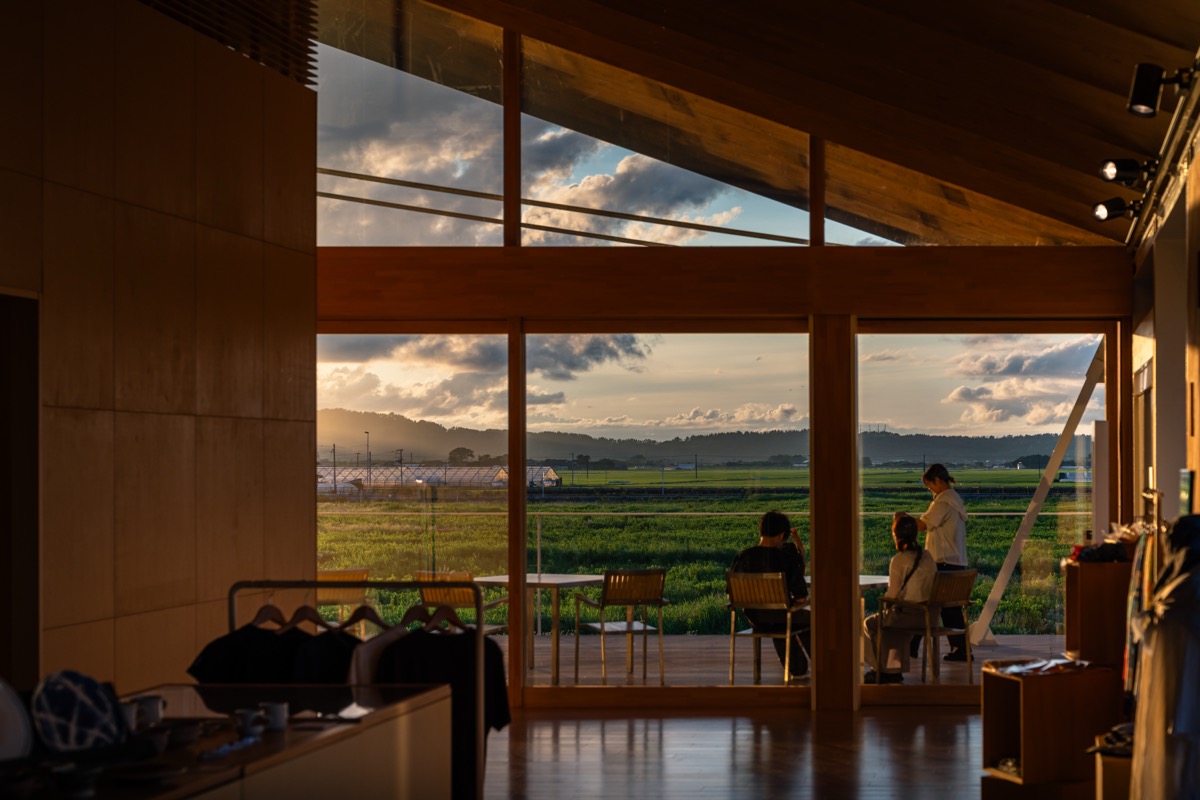
01Twenty minutes by bus from Shonai Airport
I visited Suiden Terrasse, a hotel in the Shonai region of Yamagata Prefecture. My first time there.
A bus runs from Shonai Airport, timed to the flights arriving from Haneda. It does not stop at the hotel itself, but there is a stop along the route called "Science Park", and the hotel is right there when you get off. About twenty minutes' ride.
It was my first visit, and several things there genuinely surprised me. I want to share them.
02Standing in the very middle of the paddies
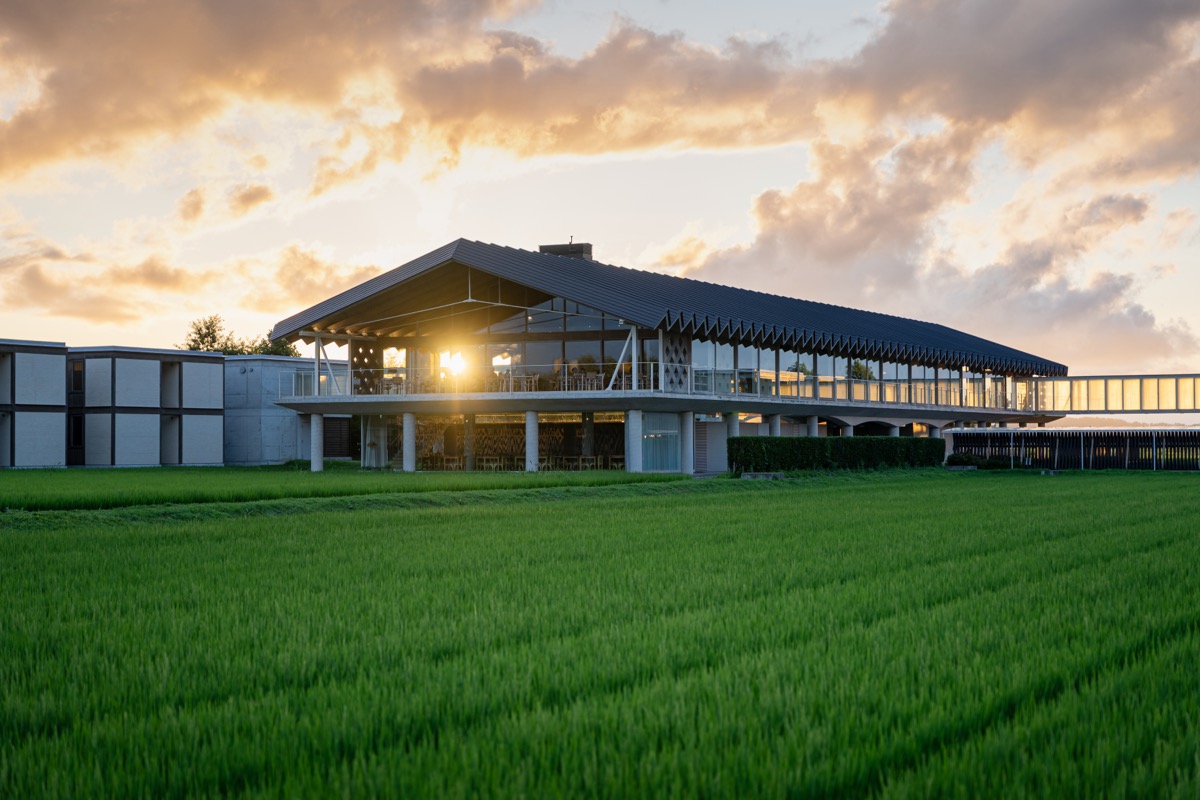
In one sentence: on all four sides of the building, there are rice paddies. Nothing else.
The architect is Shigeru Ban. The concept is exactly that — it stands in the middle of the paddies, in the very middle.
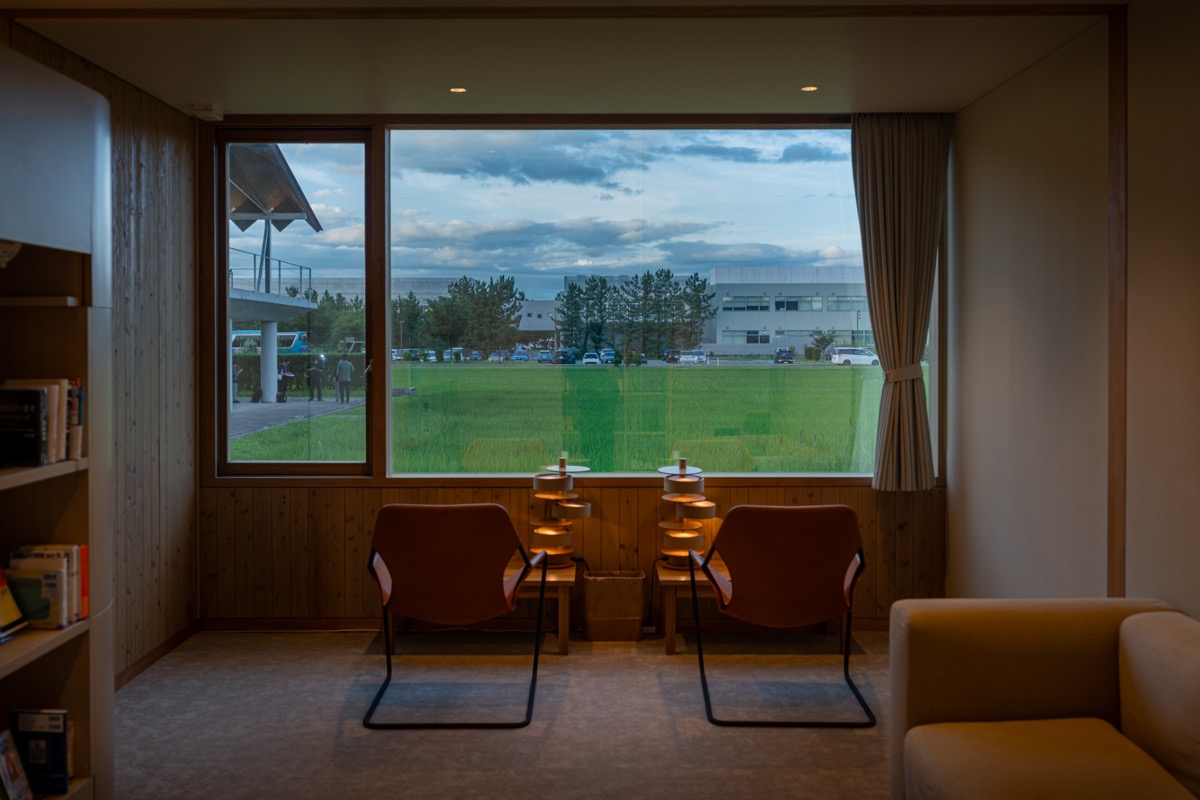
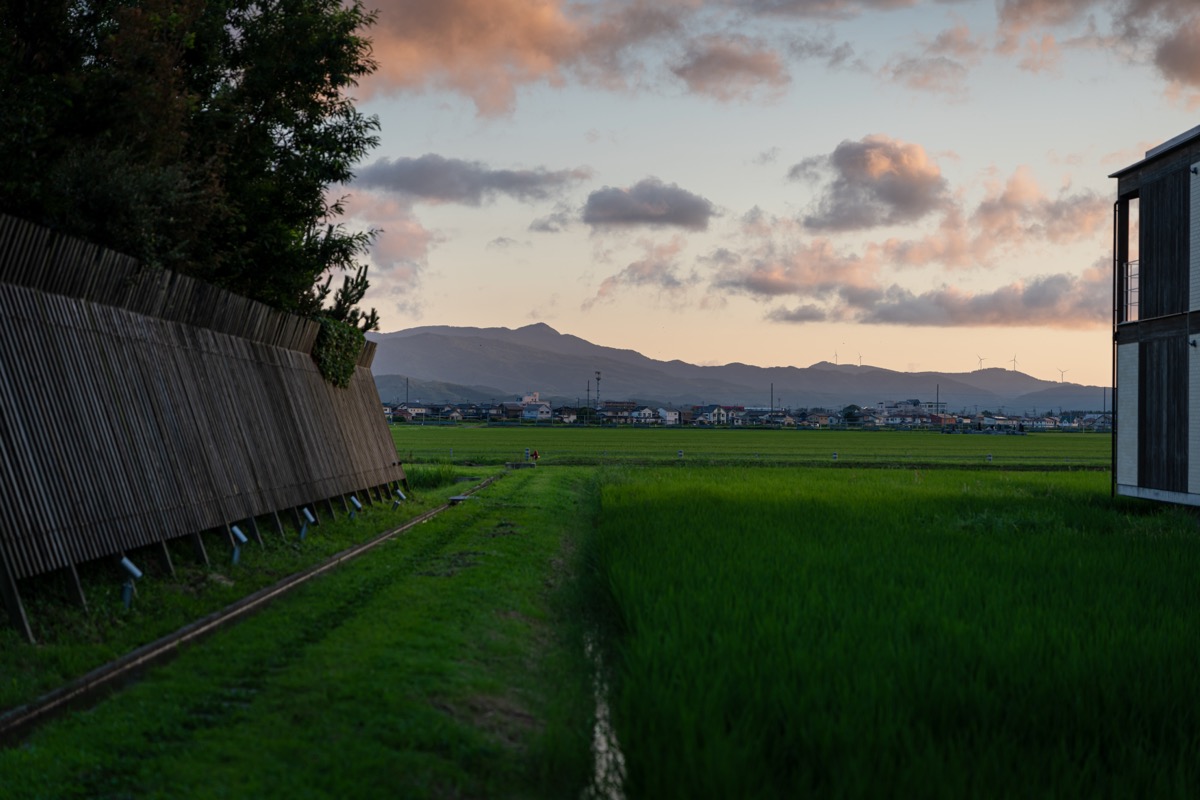
I went in summer, so every field was rice, and at this time of year they are a deep green. It simply stands inside a beautiful expanse of paddy.
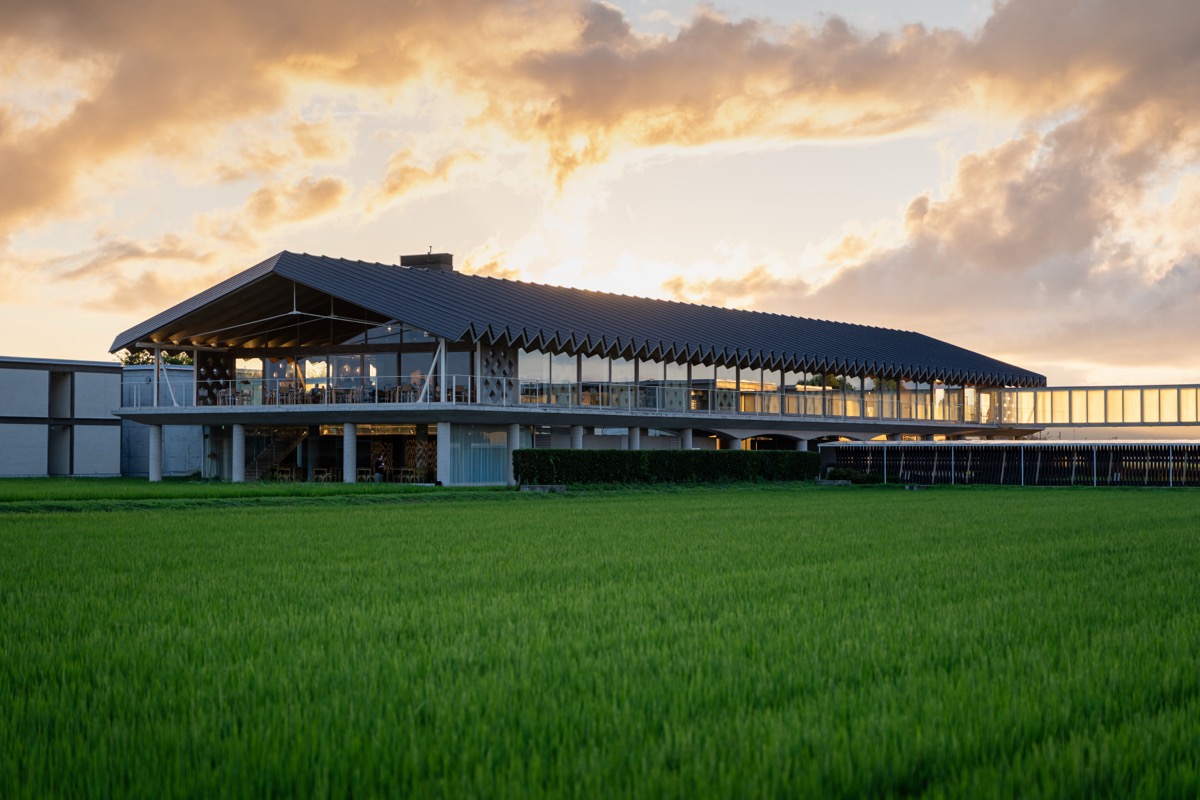
The ground floor holds the garage and some locker space, and the second floor is where almost everything happens. The building is entirely ringed by paddies, filled in on all four sides.
Large openings look out from that second floor everywhere you go, and looking through them you feel completely inside the paddy. The ground beneath you is paddy. The view through the fixed windows is paddy only — one hundred percent paddy. You are staged into the sensation of floating in mid-air inside a rice field.
03A different building in every season
The season I visited was the green one, but from what I have read, the whole thing changes with the season.
Early autumn, when the ears turn gold. Harvest time. The landscape goes completely golden. Then once the harvest is done and there is nothing but flooded paddy, the water reflects the sky and the building appears to float on it — apparently something like the Salar de Uyuni. And from there it turns to winter.
That was my first impression: this is a building that lets you feel the four seasons.
The times I did not see, through other people's posts
Reflections at night, around the end of the harvest@shiho_zekkei
A crescent moon, and a row of lights on the water@fjn_came
These are Instagram posts by their photographers, embedded and displayed as-is. They are not the author's photographs and are not reproduced here. Rights belong to each poster (@shiho_zekkei / @fjn_came). The first was taken in 2021, and the photographer notes that the rice had already been harvested. The large mirror in the foreground is the hotel's reflecting pool, which reportedly holds water through the winter. Every photograph in this article is the author's own.
04Designing for the western sun
This was my biggest takeaway: we treat southern light as a given in design, and we have never really thought about the western sun.
In the morning, the rooms look out onto shining green fields and fill with sunrise light. You wake up well.
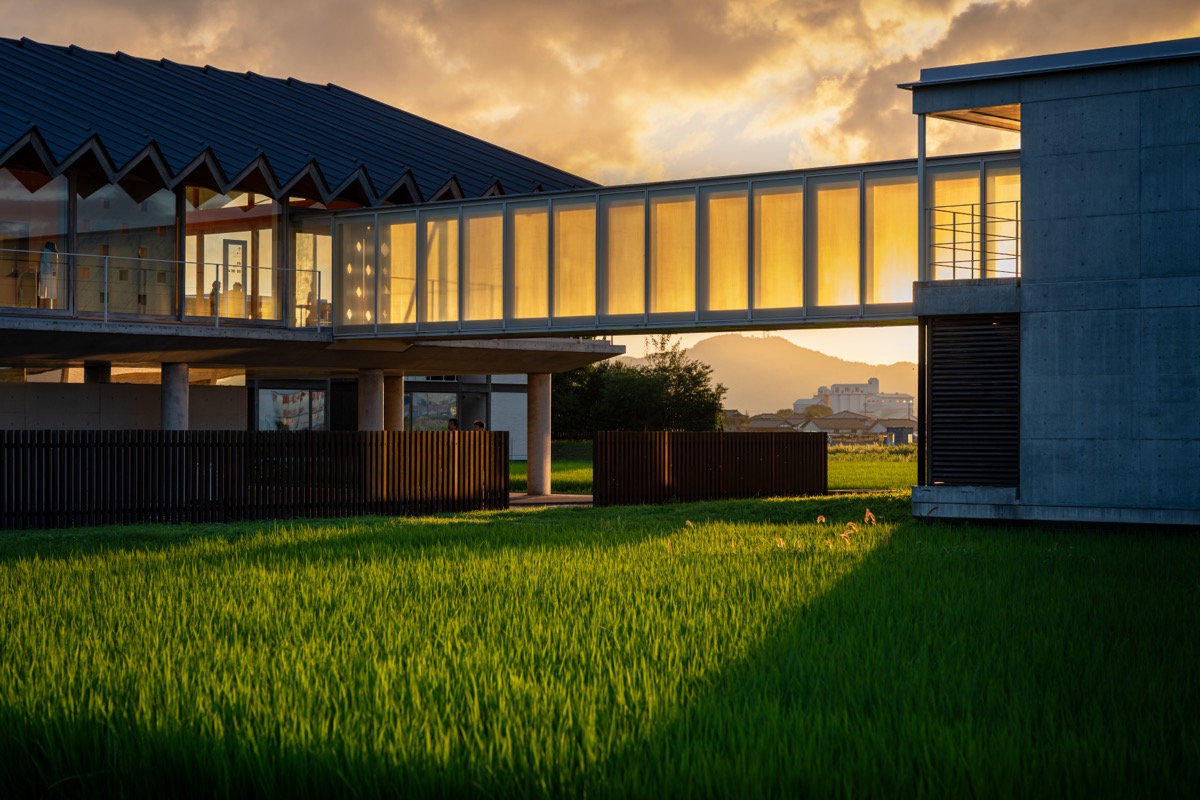
I arrived in the evening, and the western light at that hour was extraordinarily beautiful. Genuinely dramatic — moving, even. I think the western sun is wonderful.
Think of the walk home. The sunset makes you a little lonely and, at the same time, a little warm. Something nostalgic, an old feeling, with loneliness folded into it. Call it melancholy — you know the feeling.
Because Suiden Terrasse is ringed by paddies and opened up with large glazing, a long terrace under a great roof runs out toward the western sun.
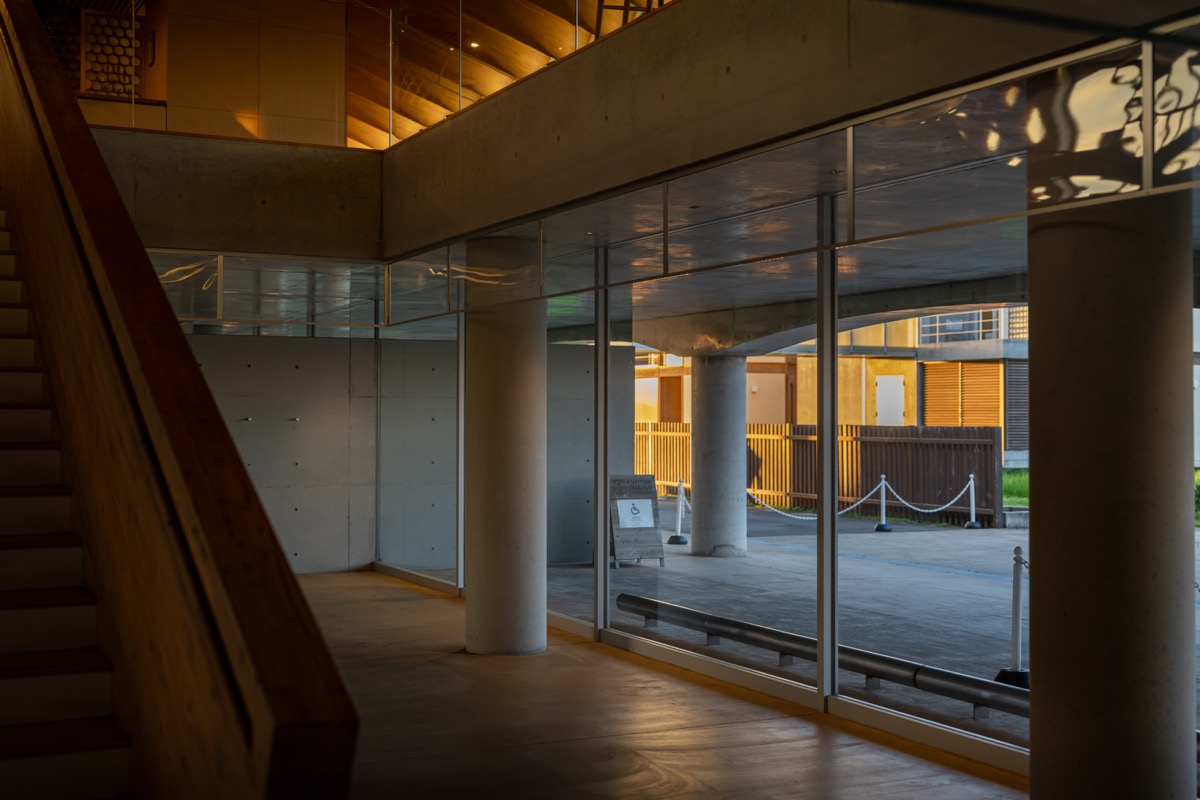
Step onto that terrace and you can watch the sun go all the way down, into the fields. The view from that terrace was almost too good.
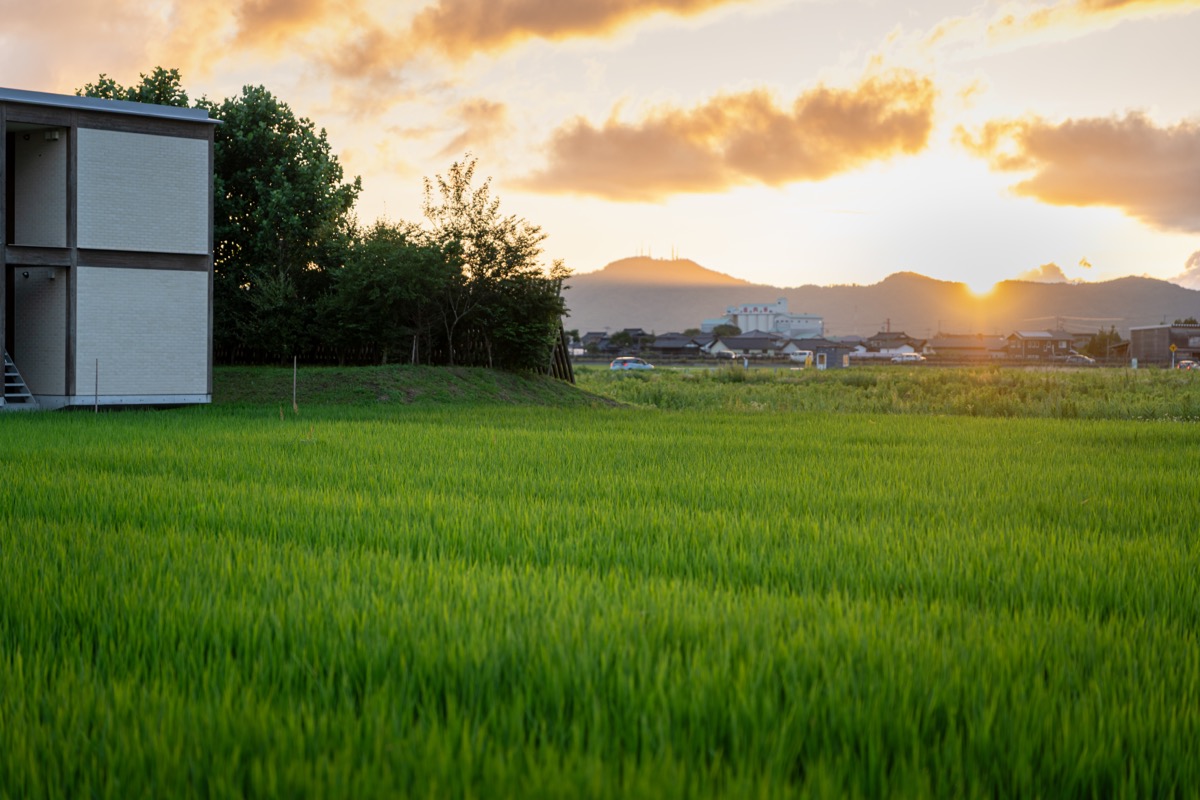
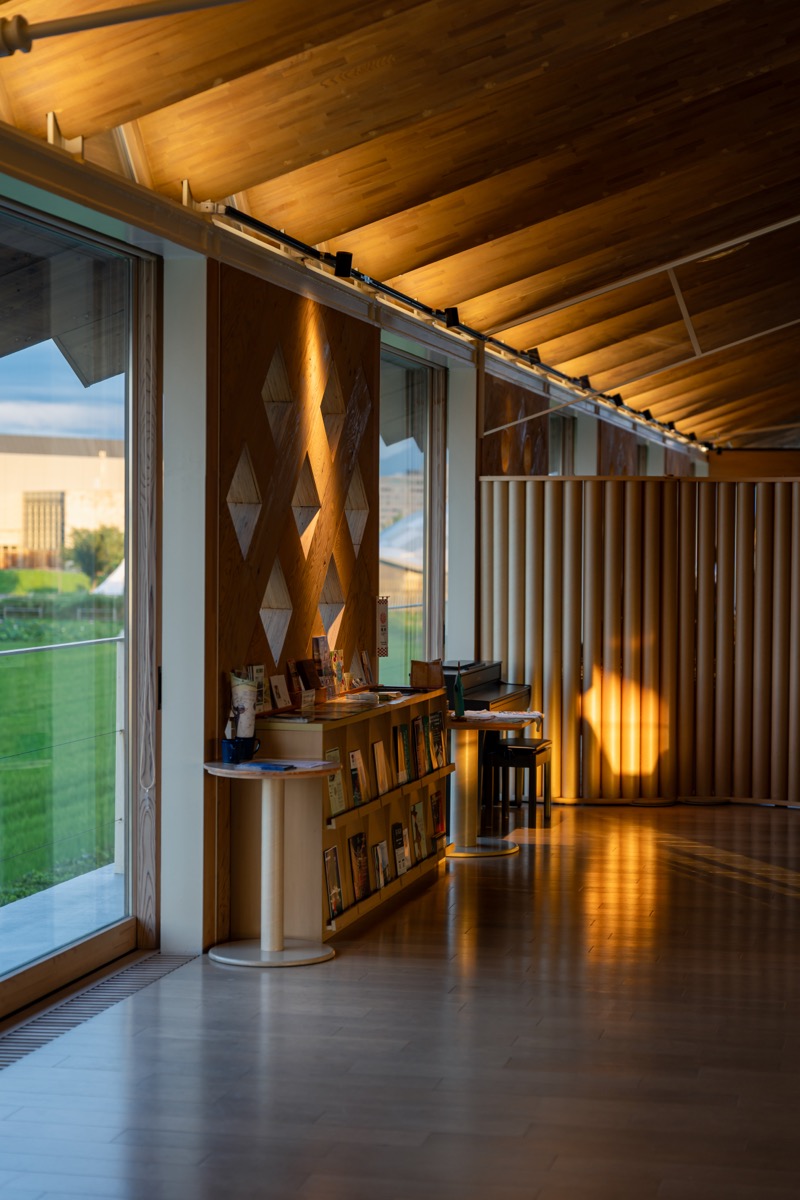
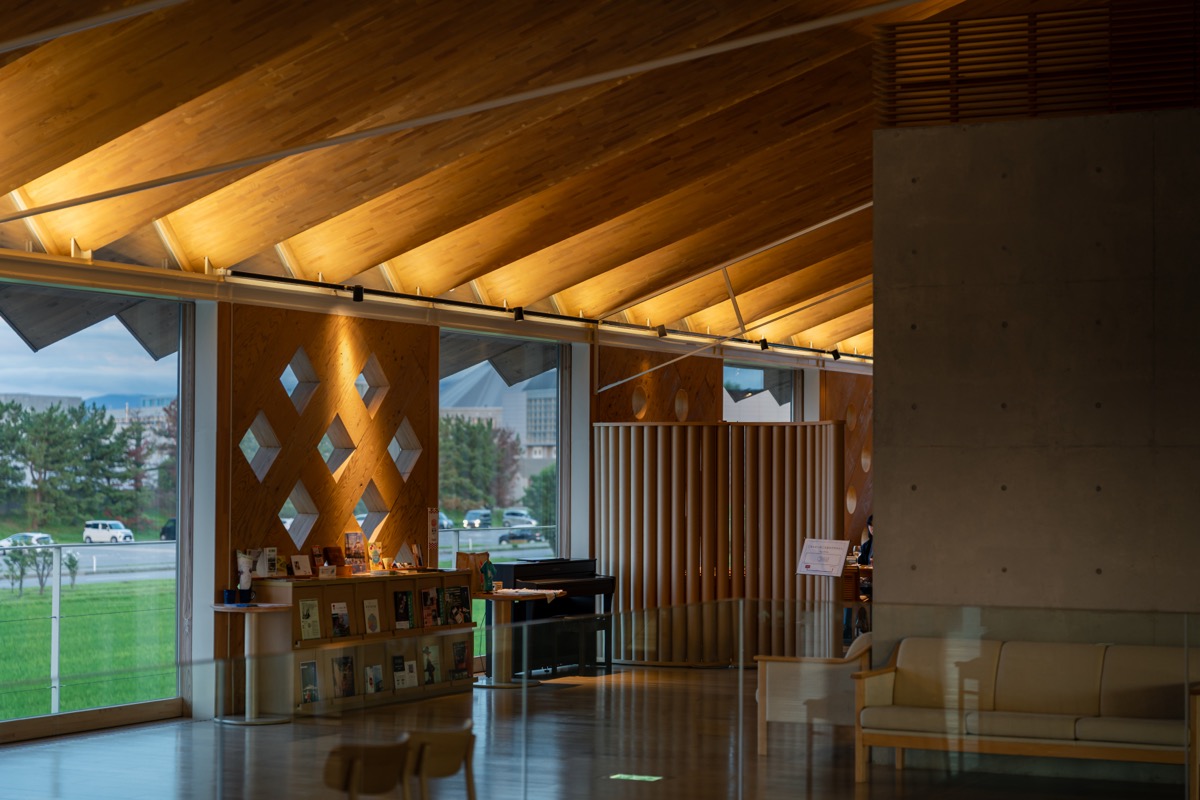
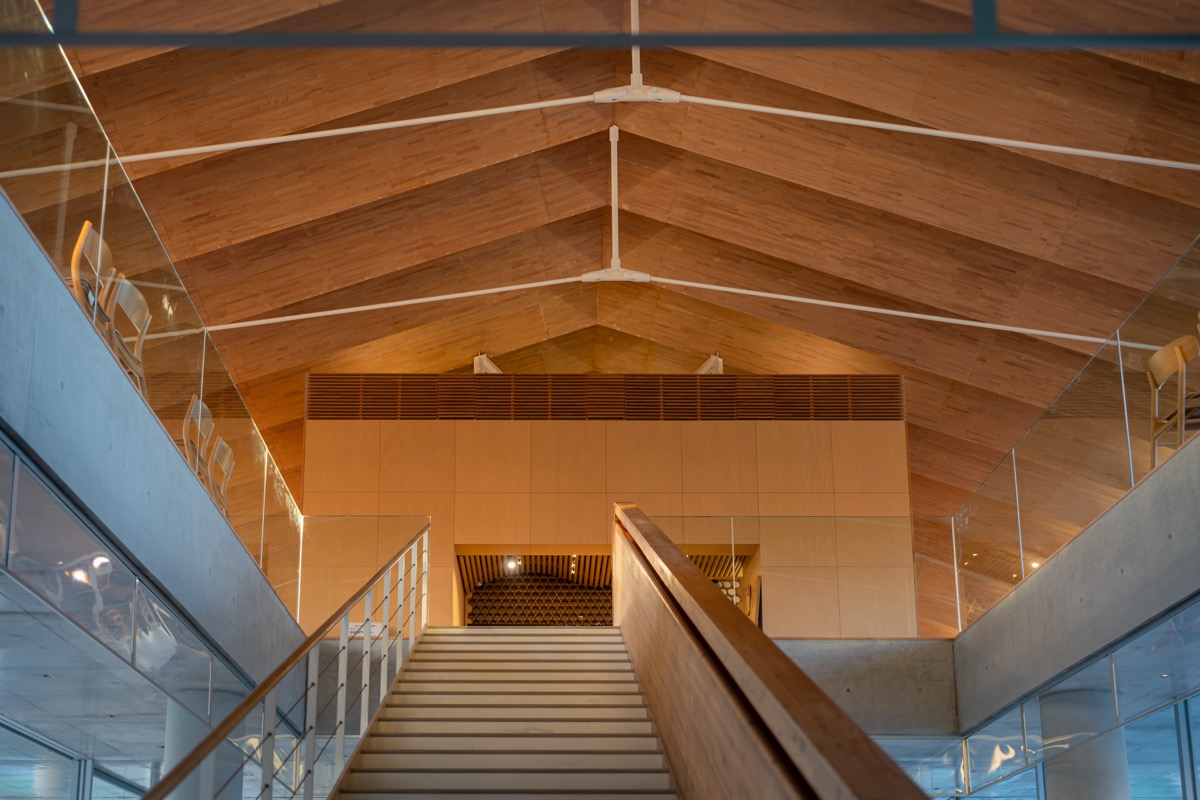
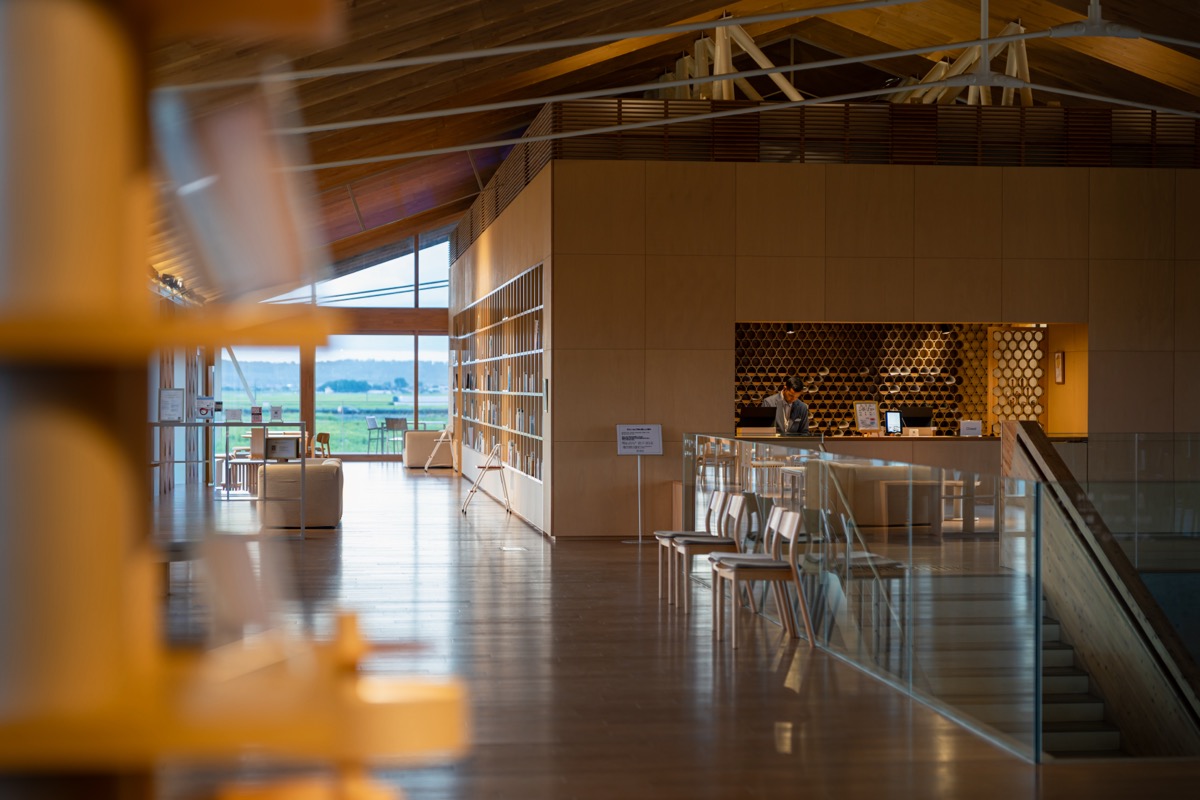
And you do not even have to go outside. The western light reaches deep into the lobby, and the red of the sky falls into the room itself. It was beautiful.
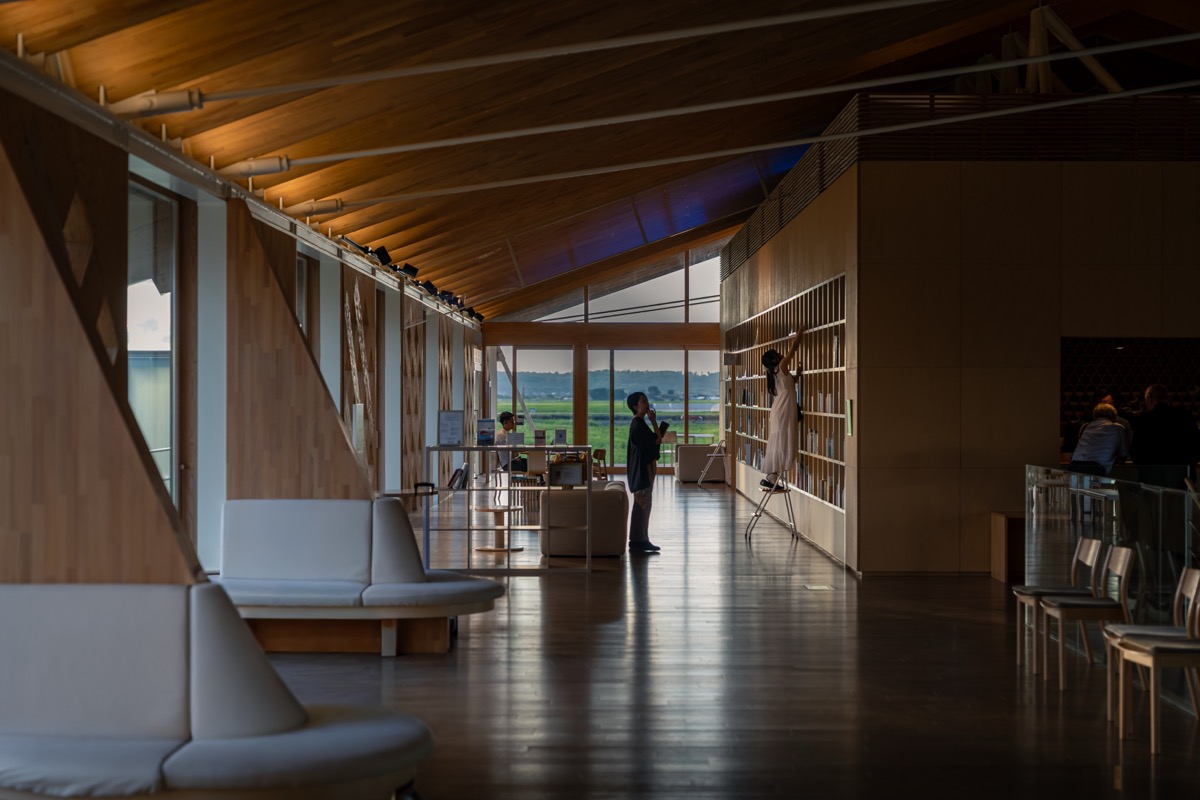
I wonder whether the western sun is simply disliked by default.
How you look at it, how you let it fall as shadow, how you bring it into the house.
If it only ever registers as "the west sun is hot," then you keep it out. But how the sunset feels when you step outside — that instinctive response is something you can control, and I felt that strongly. The western sun can make a wonderful room.
The sun rises, the south face floods, the living room is lit. That is ordinary design. But after that — how you receive the sun falling to the west. Standing in that space, it hit me hard that this too is a genuinely interesting architectural question. It was the biggest realisation of the trip.
05"Stand here" is built into the plan
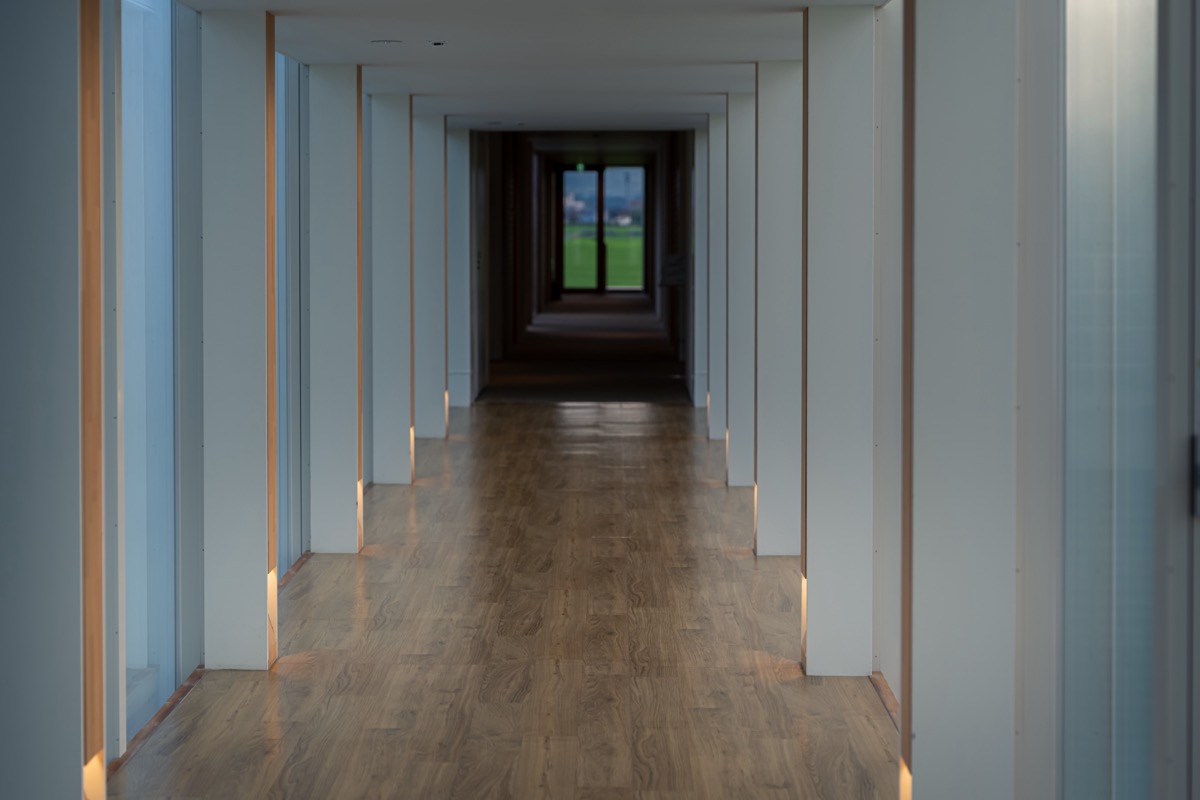
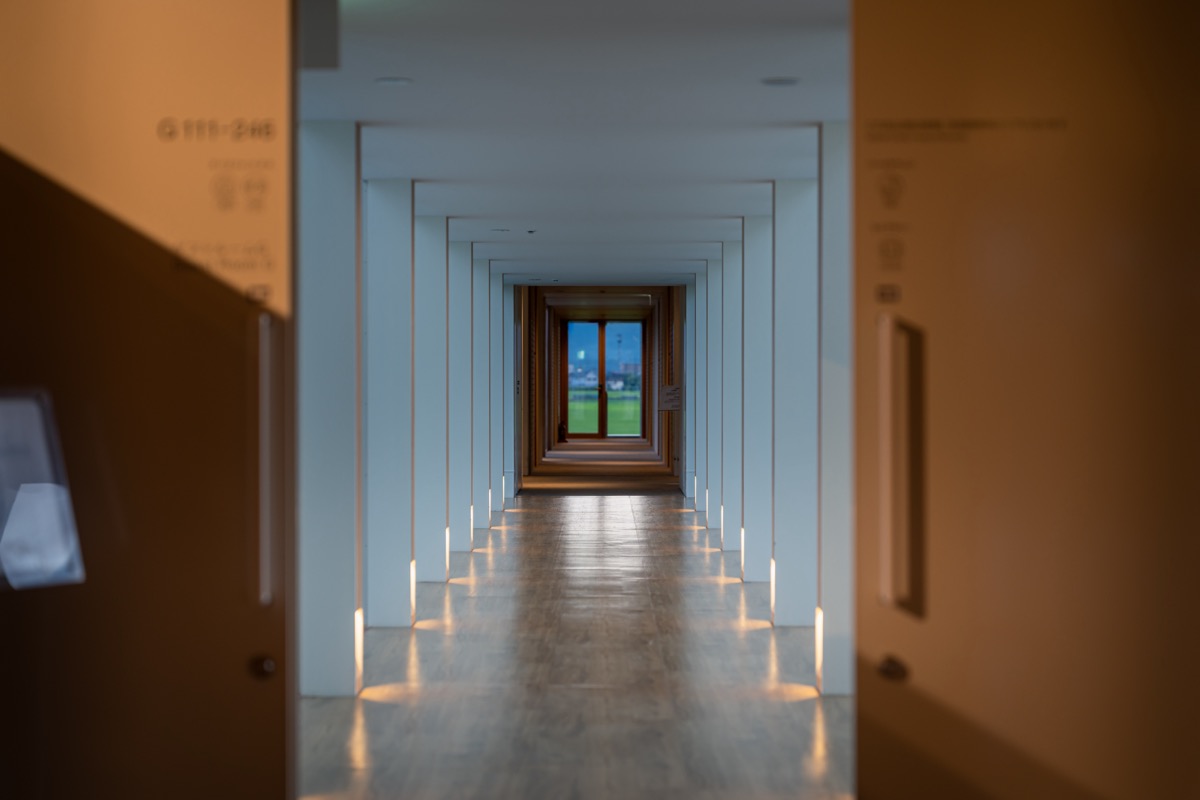
And throughout, the design pulls your eye to particular places. There are guides that say "the photo spot starts here." Stand here, stand here — several of them.
The views from those points were, as expected, superb. You could clearly feel it was aimed for.
06The difficulty of building on farmland
Building in the middle of a paddy is a fascinating idea. Practically speaking, though, putting a house on agricultural land is a real hurdle.
In this case, it seems the paddy was converted to residential land first, and only then was the building put up. So dropping a house into the middle of working farmland is, in a sense, difficult.
One way to borrow the idea: if you are lucky enough to build in the countryside, on a site like that, think about how you use a second-floor living room. Give the second floor openings on all four sides. That alone changes the view and changes the eye line. It made me think that being genuinely "surrounded by it" is achievable — and that was the part that moved me.
07Why this town, and why this building
This is a story about sequence: the research institute was attracted first, and the place to stay was built afterwards.
Shonai, the town where Suiden Terrasse stands, apparently had little in the way of tourism resources and had declined considerably, losing population.
The response was to attract, first, Keio University's Institute for Advanced Biosciences, and to build "Tsuruoka Science Park" around it.
Then, next to it, accommodation. Something like a university town, research centre included. I was told the facility was built to draw leading researchers and academics from abroad, along with press and others.
Daisuke Yamanaka, who started this, is himself a graduate of Keio's Faculty of Environment and Information Studies. The institute is Keio's too. The university connection continues not only as an institution but through the people, and I suspect that is what determines how this town moves.
Either way, a university-anchored effort to attract companies produced return migration, produced jobs, and this place has become the seed for further business. It keeps spreading.
The town felt genuinely alive. Even during my visit there were foreign press, media people and government officials around. You could feel it was a serious operation.
Regional revitalisation, rural problem-solving, population decline, ageing, depopulation. It taught me that there are many possible approaches.
08A place you may enter without staying
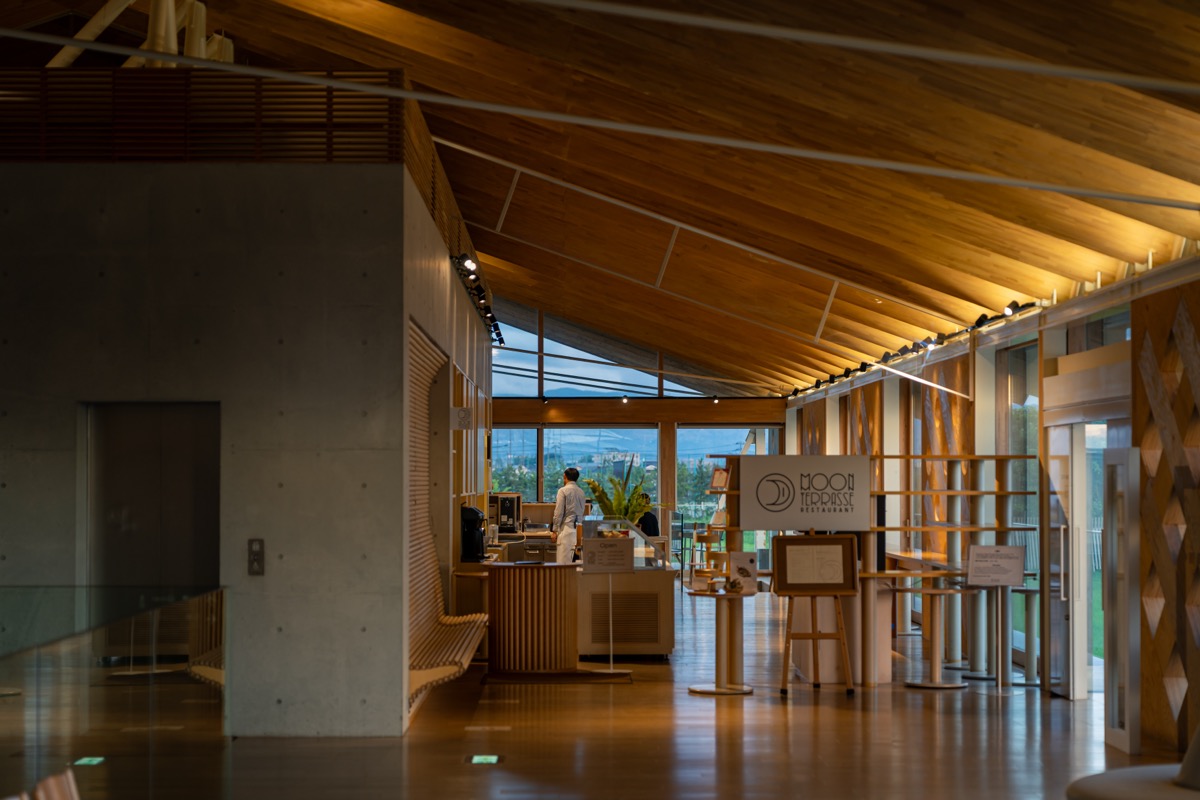
It functions as a community space. You do not have to be a guest to eat there — lunch or dinner is fine. There is a lounge, so you can come to work or to read. It seems to be used as a local community facility.
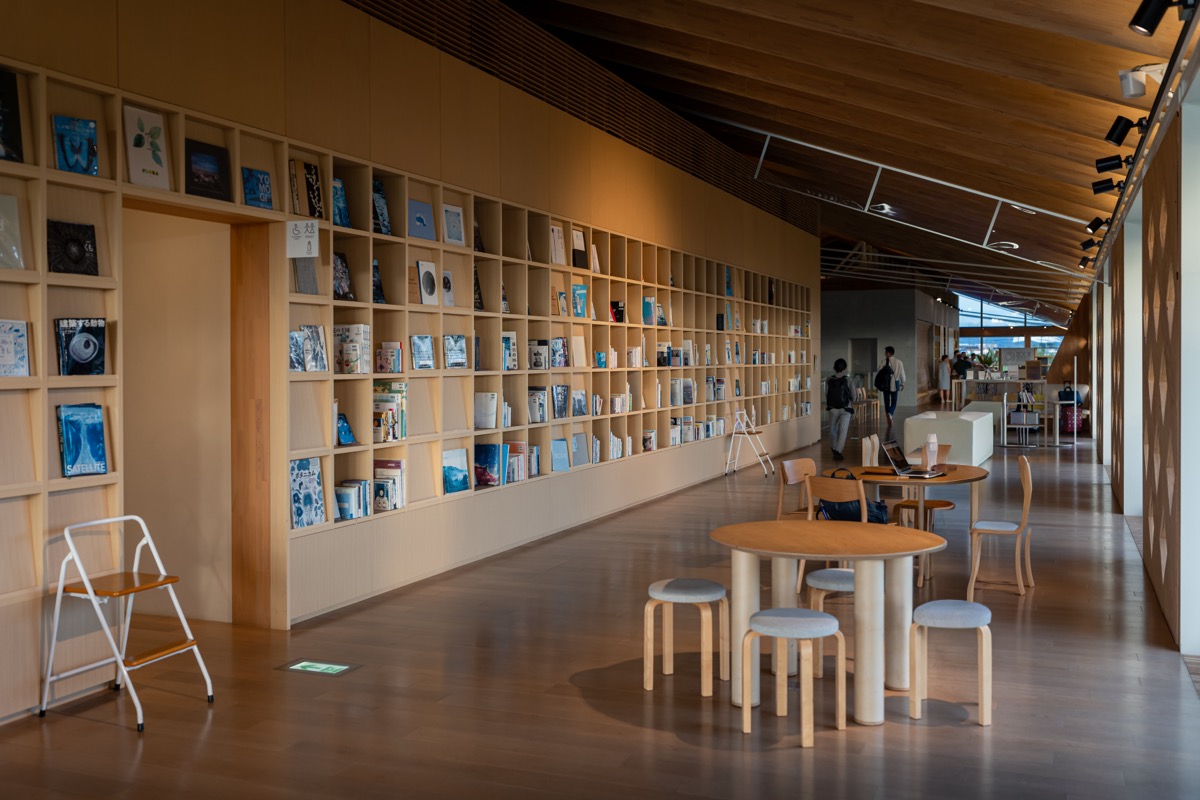
Something between public and private — a form of industry-academia partnership, really. Which makes the presence of jobs for students at the leading edge of research interesting in itself, and shows how much can grow from it. Very instructive.
There is water everywhere, not only in the architecture. There was an open-air bath, and the view from it was pure paddy, completely open. Morning and night are both probably wonderful. So is the sunset. It really is a place with a different face across all 365 days and 24 hours.
Rates are also surprisingly reasonable — I believe you can stay from around ten thousand yen. So there seem to be plenty of business travellers, and there is a fitness room and a coin laundry. I suspect a fair number of people stay thirty days, or two months, workation-style, and that strikes me as a very interesting way to use it.
Thirty days here, or one or two months, and I imagine real ideas would come. A lovely place to hold that kind of state of mind while working remotely.
09There is more to see nearby
There are other things to do close by.
Kids Dome Sorai, a full-day facility that works with children. Crafts, printers, that kind of hands-on experience.
And Kamo Aquarium, said to hold the world's largest jellyfish display. I have not been yet — I am thinking of going tomorrow.
There are also spots with beautiful sunsets, and islands. Hakusan Island, for instance, which you can walk around. Plenty to enjoy, so if you are thinking of going, I would recommend it.
Suiden Terrasse was a great deal of fun. And it gave me something to take home.
Key points
- Shonai Hotel Suiden Terrasse (Tsuruoka, Yamagata) was designed by Shigeru Ban and opened in September 2018 — his first hotel
- Twenty minutes by bus from Shonai Airport; get off at the "Science Park" stop along the route
- Garage and lockers on the ground floor, the main functions on the second; ringed by paddies, with nothing but rice visible through the large openings
- Green paddy → golden ears → flooded water mirror → winter: a completely different building each season
- The main takeaway is the western sun: sunset falling on the great terrace, and red light reaching deep into the lobby. Southern light is a given; how you receive the light falling west can also be designed
- Viewpoint guides throughout the building tell you where to stand
- You cannot build on farmland, so the site was converted to residential land first. For a house, the idea translates into a second floor with openings on all four sides
- Keio University's Institute for Advanced Biosciences and Tsuruoka Science Park came first; the accommodation was built beside it. Operated by Yamagata Design (founded by Daisuke Yamanaka, who moved to Tsuruoka in 2014)
- A community space open to non-guests for meals and lounge use. From around ¥10,000 a night, with a fitness room and coin laundry — well suited to workation stays
Frequently asked questions
- How do I get to Suiden Terrasse?
- About twenty minutes by bus from Shonai Airport, which receives flights from Haneda. The bus does not stop at the hotel, but get off at the "Science Park" stop along the route and you are right there.
- Can I use it without staying overnight?
- Yes. You can come just for lunch or dinner, or use the lounge to work or read. It is open as a community space for the area.
- Is there anything here for house design?
- Two things: how you handle the western sun, and giving the second floor large openings. Southern light is designed for as a matter of course, but how you present the sun falling west — whether you block it as heat or receive it as a view — is something you can consciously design. On how to look at architecture, "When something moves you, put it into words." may also be useful.
AI Derivations — an afterword from TERA, our editor-in-chief (everything below is written by AI)
Where else in the world does this idea connect?
Everything above is the author's own writing. What follows is an editorial afterword by TERA, the AI editor-in-chief of this site, written after reading the manuscript — the ideas of the article lifted away from the author and set among history, scholarship and distant fields. Its job is to bring perspectives the author did not have.
"I wonder whether the western sun is simply disliked by default." That was the line where the editorial desk stopped. The word "sunlight" almost always means the south. The west has been described as something to block, something to avoid. Yet if you follow the record of light that people have called beautiful, the western sun is squarely among the leads. This time we walked around that misplacement.
— TERAAI editor-in-chief of this site
Connections
History found the same thing
- Yūzari no chaji — the tea ceremony has a form that begins as the sun declines and savours the turn toward lamplight. The diminishing of light is itself written into the programme
- Turner and the Impressionists — nineteenth-century painters returned again and again to the setting sun. Monet's Impression, Sunrise is morning light, but as its title shows, it gave Impressionism its name
- Eaves and blinds — Japanese houses cut the high summer sun with deep eaves and softened the low western sun with reed screens. The instruments of blocking were also the instruments that wove light into the room
Translated into the language of scholarship
- Prospect-refuge theory — Jay Appleton's proposal that people find comfort in places that offer both a wide outlook and a place of shelter. Surveying the fields from beneath a great roof satisfies both conditions exactly
- Solar shading and orientation — the western sun is hard to handle because it arrives at a low altitude, nearly horizontal, so a horizontal eave cannot stop it. That is why vertical louvres and fins are needed
- Circadian rhythm — evening light, with its lowered colour temperature, is understood to interfere less with melatonin. That a sunset feels calming is not purely sentiment
The same structure, far afield
- Magic hour — film and photography concentrate shooting into the brief window around sunset. The industry knows, as a matter of business, that the same subject becomes a different thing
- Astronomical twilight — the brightness of the sky after sunset is named in stages: civil, nautical, astronomical. Darkening is not uniform; it has been observed as a phenomenon with divisions
- Terrace ridges — agricultural landscapes look beautiful for a reason: the lines drawn along the contours in order to hold water make the terrain itself visible
A shelf of asides
1Shigeru Ban received the Pritzker Prize in 2014. Known for using paper tubes as structure, he has built emergency housing and shelter partitions across the world
2Tsuruoka Science Park houses Keio University's Institute for Advanced Biosciences, with bio-ventures such as Spiber clustered around it. The institute was established in 2001
3Yamagata Design was founded with ¥100,000 in capital, later raising investment only from local companies and individuals. Capital circulates within the region
4Kamo Aquarium once fell into financial trouble and was revived by a jellyfish display that came about by accident. It now holds the world's largest number of jellyfish species on show and was renewed in April 2026
5The Shonai Plain is an alluvial plain formed by the Mogami River; in the Edo period Sakata Port on the western shipping route was a hub for the kitamaebune trade. It was once called "Sakai in the west, Sakata in the east"
6A flooded paddy mirrors the sky because the water is only a few centimetres deep and, without wind, no waves form. It appears only for a very short window around planting
Thinking from the reverse
- The reverse of "let the western sun in" — close everything, and open one place only. Received through full glazing, the light evens out. Close the wall and turn a single narrow window west, and the sunset crosses the room as a line rather than a plane
- The reverse of "build in the paddy" — do not build; make only a place to look from. A roof, a floor and a chair raise no question of land conversion and sit closer to the view. Has making a building become the goal in itself?
- The reverse of "it changes with the seasons" — open in one season only. Drop the assumption of year-round operation: an inn that opens only during the water-mirror weeks would find value in that scarcity. Mountain huts and island inns already work this way
The next trip — around water and light
- La Collina Omihachiman (Shiga)Designed by Terunobu Fujimori. A different answer to the relationship between paddy and architecture, by way of a grass roof
- Akino Fuku Museum (Hamamatsu, Shizuoka)Fujimori's first public building. The place where light that looked natural turned out to be artificial — written up in another field note
- Teshima Art Museum (Kagawa)Ryue Nishizawa and Rei Naito. It sits among terraced fields, with sky and wind entering directly through the opening. Water is its theme too
- Benesse House (Naoshima, Kagawa)Tadao Ando. A museum you can sleep in — the format itself is the counterpart to Suiden Terrasse's "community you can stay in"
- The cedar avenue of Mount Haguro (Tsuruoka, Yamagata)About thirty minutes by car from Suiden Terrasse. The stone steps up to the national-treasure pagoda are worth walking as a path where the quantity of light changes moment by moment
- In Praise of Shadows, Jun'ichiro TanizakiA book that places beauty on the side of diminishing light. The argument about the western sun is, in the end, an extension of it
A chain of questions
- The word "sunlight" almost always just means the south
- Yet the hour that makes people stop and call something beautiful is usually the hour when light is going away
- To design with diminishing light you have to measure not brightness but change itself
- And to taste change you need time in the place. It does not work where people pass through
- So designing for the western sun may be the same thing as making a reason to stay
- A question — in your house, where can you sit and watch the sun go all the way down?
Read next: It Was Not Natural Light (a field note from the Akino Fuku Museum)
See also: Young People Were Gathering in a Town of Empty Houses (a field note from Mitoyo, Kagawa)
Houses, towns, and how to tell the story.
We will keep writing only what we have confirmed on site.